
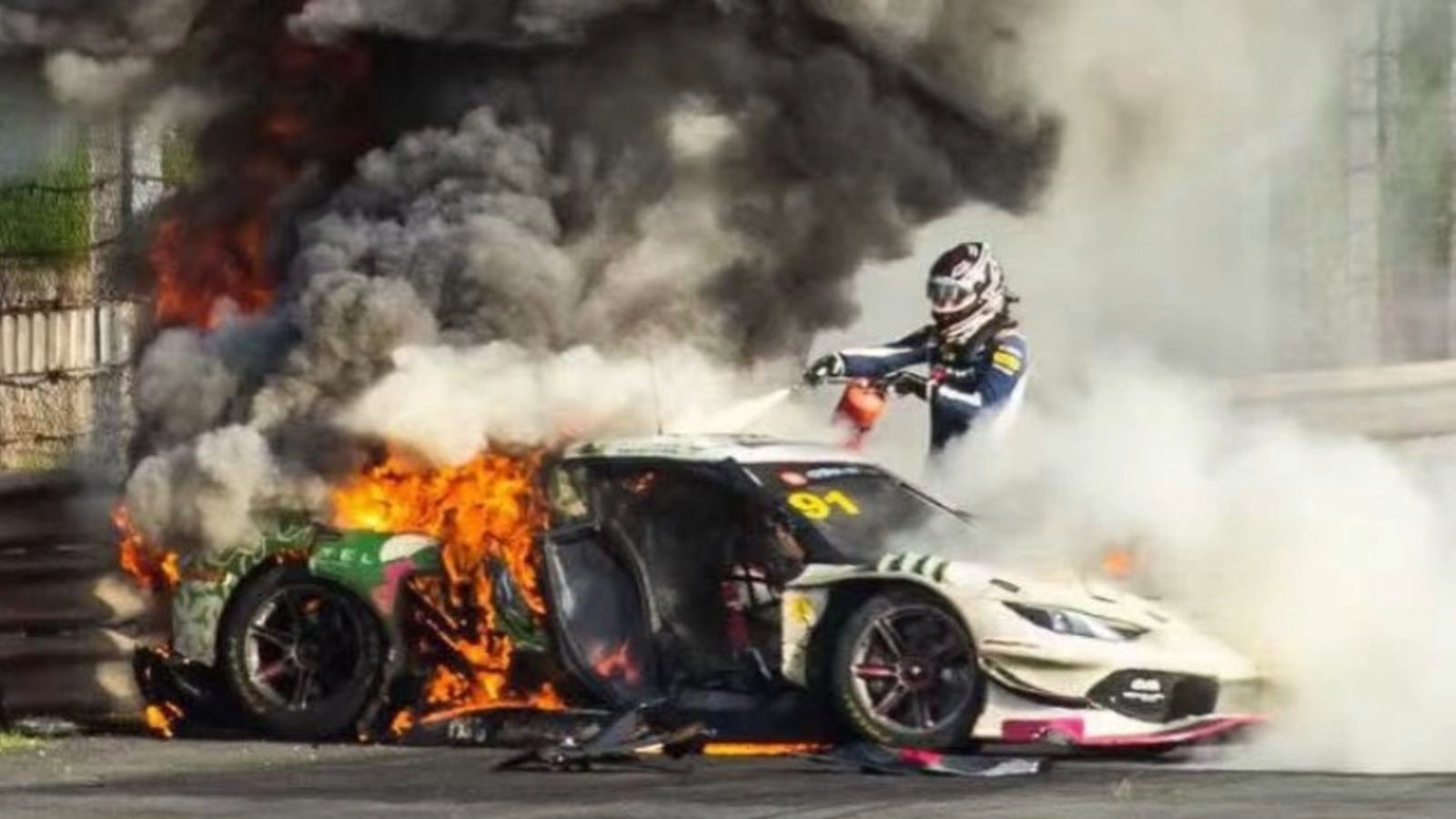
SHANGHAI: British racing driver Ollie Millroy says he owes his life to fellow competitor Loek Hartog after the Dutchman stopped during a China GT race and helped pull him from a Ferrari that had caught fire following a multi-car collision.
The crash happened during the opening China GT race at the Shanghai International Circuit on September 5, with Millroy’s Ferrari becoming engulfed in flames after a collision involving other cars.
Hartog, competing in a Porsche, stopped his car and ran towards the wreck. He first attempted to reach Millroy directly before obtaining a fire extinguisher and using it to suppress the flames. He then helped free the trapped driver from the damaged Ferrari.
Millroy later thanked Hartog publicly, saying he was alive because of the 23-year-old Dutch driver. He also said he had no memory of the period immediately surrounding the crash.
The rescue has since become the defining moment of the incident, while questions have emerged over the speed and effectiveness of the official emergency response.
How the China GT crash unfolded
The accident occurred around 20 minutes into the race, with reports identifying the incident near Turn 14 at the Shanghai circuit.
Neil Verhagen’s BMW and David Chen’s Ferrari made contact during a battle, with the BMW losing control after moving onto the grass. The cars subsequently became involved in a collision that sent one of them into Millroy’s Ferrari. Millroy’s car caught fire after the impact.
Hartog was among the drivers approaching the scene and immediately abandoned his own car to assist.
According to accounts of the incident, he tried to reach Millroy through the driver’s side before using a fire extinguisher. He then managed to get Millroy out of the burning vehicle.
The race was stopped following the crash and did not resume.
Millroy suffered multiple injuries
Millroy survived the crash but suffered several serious injuries.
Reports have cited broken ribs, a fractured collarbone, injuries to his hand and finger, and a lung injury. Later updates said he underwent surgery and remained in hospital in Shanghai.
Millroy said he could not remember what happened from shortly before the collision until around an hour afterwards.
His message to Hartog underlined the seriousness of the situation, crediting the Dutchman with giving him a chance to survive.
Hartog, however, played down the description of himself as a hero. He said he had acted instinctively after seeing the burning car and believing the driver might not be able to escape alone.
Questions over emergency response
The rescue has also triggered criticism of the organisation of the China GT event.
Millroy’s team, AAI Motorsport, criticised the response to the accident and announced that it would no longer participate in China GT events until concerns surrounding safety and the handling of the incident were addressed.
The team also disputed the initial description of the incident during the live broadcast, arguing that Millroy had not simply escaped from the car by himself.
China GT organisers subsequently acknowledged shortcomings in areas including competition organisation, emergency response, rescue and medical services. They said the incident would be investigated and that improvements would be developed.
The organisers also said an initial assessment found that the overall event arrangements met national-level competition requirements, while acknowledging that detailed management required improvement.
A rival became the rescuer
Motor racing routinely places competitors in direct competition, but the Shanghai incident produced a very different image.
Hartog abandoned his own race at a moment when the situation around Millroy’s Ferrari remained dangerous. Rather than continuing, he moved towards the burning vehicle and attempted to help the trapped driver.
Millroy’s gratitude has made Hartog’s intervention the central human story from the crash.
For the China GT organisers, however, the incident is now also a test of whether emergency systems can respond quickly enough when a serious accident occurs.
The promised investigation is expected to examine the organisation of rescue and medical services and identify measures to prevent a similar situation in future.
What happened to Ollie Millroy?
Ollie Millroy was involved in a multi-car China GT crash at the Shanghai International Circuit on September 5. His Ferrari caught fire and he was rescued from the vehicle by rival driver Loek Hartog.
Who rescued Ollie Millroy?
Dutch racing driver Loek Hartog stopped his Porsche, went to the burning Ferrari and used a fire extinguisher before helping Millroy out of the wreckage.
Where did the China GT crash happen?
The crash occurred at the Shanghai International Circuit in Shanghai, China, during the opening China GT race.
What injuries did Ollie Millroy suffer?
Reports said Millroy suffered multiple injuries including broken ribs, a fractured collarbone, hand and finger injuries and a lung injury. Later reports said he underwent surgery.
Did the China GT race continue after the crash?
No. The race was stopped following the incident and did not resume.
Why has the China GT event faced criticism?
Millroy’s team criticised the emergency response, while China GT organisers acknowledged shortcomings in competition organisation, emergency response, rescue and medical services and promised an investigation.
What did Loek Hartog say about the rescue?
Hartog described his actions as instinctive, saying he believed the driver might not be able to escape the burning car by himself.
