
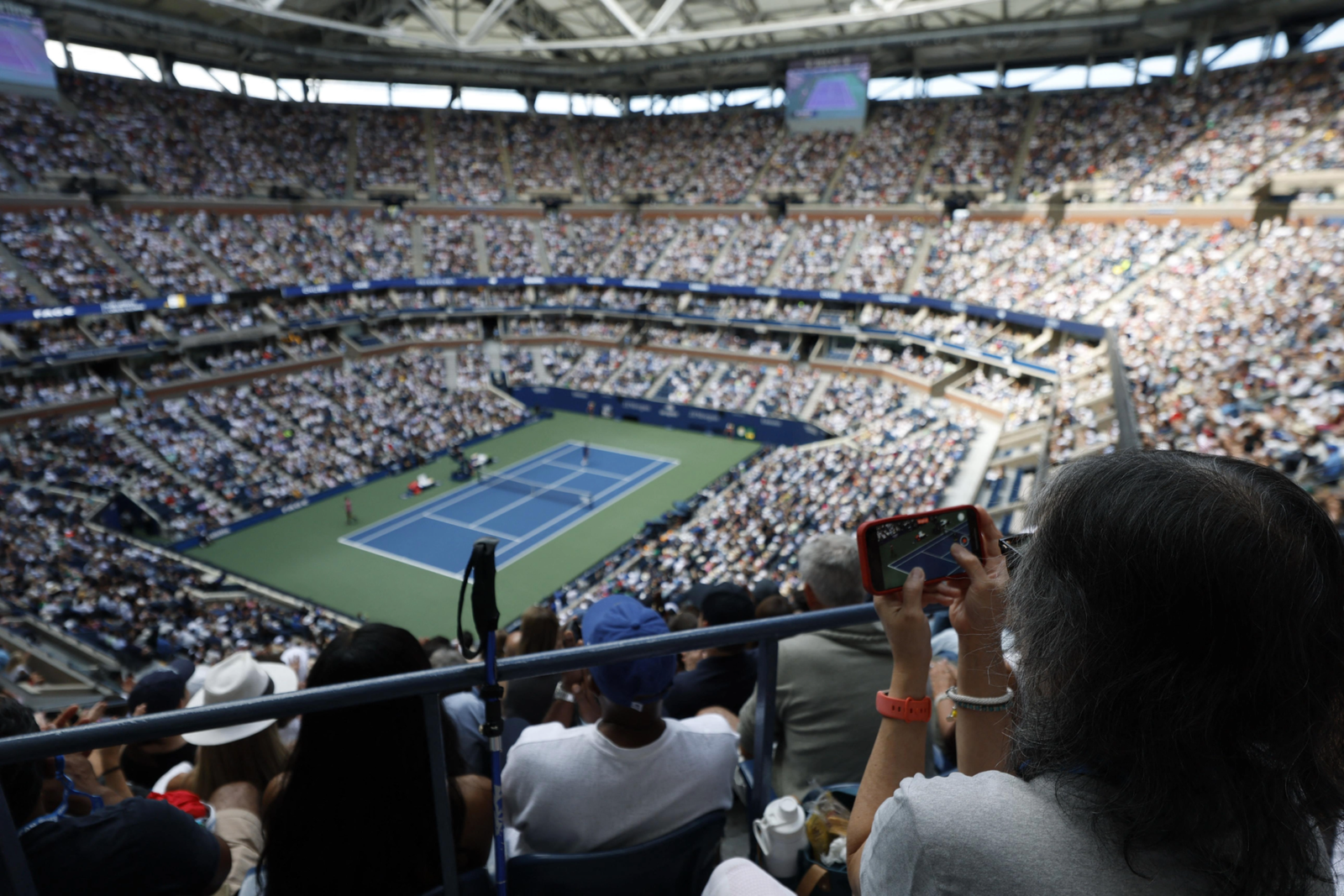
LONDON: Wimbledon is taking a more cautious approach to social-media influencers after the 2026 US Open became the centre of a growing debate over how much content creation belongs inside a live tennis match.
The All England Club does not plan to introduce a dedicated accreditation category for influencers or content creators, according to reporting by the Press Association. Security is also expected to confiscate equipment such as ring lights if it is considered capable of disrupting play.
The position contrasts with the US Open, where organisers expanded their creator programme this year. About 100 content creators received credentials for the New York Grand Slam, nearly twice the 54 who were credentialed when the programme began in 2025.
The issue moved beyond social media after activity in the stands interrupted Naomi Osaka’s first-round match against Anastasia Zakharova at Arthur Ashe Stadium on August 31.
A group in a stadium suite was reported to have been making content during play, with noise and bright lighting prompting chair umpire Kader Nouni to intervene. The incident became a wider discussion about whether efforts to attract younger digital audiences were beginning to conflict with the concentration required during professional tennis matches.
Wimbledon opts for a different model
Wimbledon’s approach is rooted in rules that already place significant restrictions on what spectators and accredited media can record or transmit.
The All England Club’s published accreditation terms regulate social-media activity by accredited media and place restrictions on the reproduction and transmission of match material. Its conditions of entry also limit recording and transmitting venue or match content for commercial purposes by ordinary ticket holders.
That means the latest move should not necessarily be interpreted as a blanket prohibition on anyone who has a social-media following attending Wimbledon. Instead, the significant change is that the tournament does not intend to replicate the US Open’s dedicated influencer accreditation model.
The All England Club reviews its policies, including those concerning social media, annually. The decision therefore reflects Wimbledon’s established approach to managing access and conduct rather than a completely new set of rules introduced overnight.
US Open experiment sparks wider tennis debate
The controversy at Flushing Meadows has highlighted a difficult balancing act for major sporting events.
Content creators can introduce tournaments to audiences that may not follow traditional sports media. The USTA’s decision to expand creator credentials was explicitly designed to broaden the range of coverage and reach people through the platforms where they consume content.
But the increased presence also brought new challenges.
Reuters reported that around 100 creators had credentials at this year’s US Open, including about 20 focused on food and beverage coverage. The tournament has increasingly positioned itself as a major cultural and entertainment event alongside its sporting role.
The debate intensified when players spoke publicly about spectator behaviour.
Osaka called for greater awareness of tennis etiquette after distractions during her matches, while Coco Gauff and Jessica Pegula also raised concerns about behaviour that can interfere with players’ concentration. The USTA subsequently increased reminders to spectators about appropriate conduct.
The important distinction is that not every influencer at the US Open was responsible for the incidents. Reports have also indicated that some people involved in disruptive episodes were not among the officially credentialed creators. That makes the issue broader than accreditation alone: tournament organisers must manage the behaviour of everyone inside the venue, including invited guests, brands and ordinary ticket holders.
What Wimbledon’s decision means
For Wimbledon, the priority appears to be preserving its established match-day environment while continuing to use digital media through controlled channels.
The tournament already operates detailed rules governing media accreditation, photography, video and social-media publication. Those provisions give the All England Club significant control over how match content is captured and distributed.
The latest decision therefore represents a more conservative route than the one taken by the US Open.
For international tennis fans, including audiences in the UAE and wider Gulf region, the dispute is part of a broader change in how major sporting events are marketed. Social platforms have become an important way for tournaments, sponsors and athletes to reach younger audiences, but live sport still depends on spectators allowing competitors to perform without unnecessary distractions.
Wimbledon appears to be betting that digital engagement can grow without turning the stands into production studios.
