
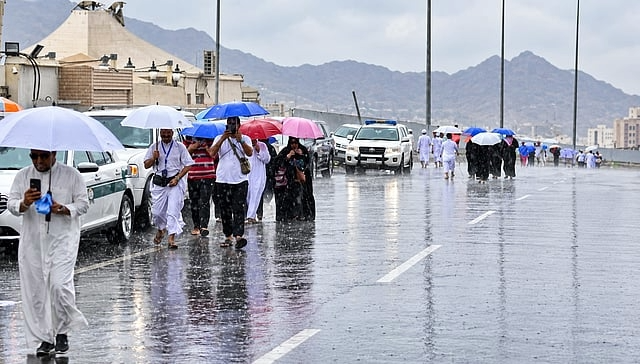
Saudi Arabia is preparing for a wetter-than-usual three-month period, with above-average rainfall expected across several regions between November 2026 and January 2027. The country’s National Center for Meteorology (NCM) has also forecast warmer-than-normal surface temperatures across all regions during the same period.
The climate outlook, released on November 2, identifies different rainfall patterns for each month, with some areas potentially experiencing heavy to very heavy precipitation in November before rainfall opportunities shift across southern and central parts of the Kingdom in December and January.
The forecast covers the Northern Borders, Riyadh, Makkah, the Eastern Province, Asir, Jazan and several other regions. The expected rainfall intensity varies by location and month, according to the NCM report published by the Saudi Press Agency (SPA).
November: Several regions face the prospect of heavy rain
November is expected to bring particularly wet conditions to parts of northern and central Saudi Arabia.
The NCM outlook identifies the Northern Borders Region, along with parts of Qassim, Riyadh, the Eastern Province and Makkah, as areas where rainfall could exceed seasonal averages. Precipitation in these locations may range from heavy to very heavy, with some areas potentially experiencing extremely heavy rainfall.
Other regions, including Tabuk, Al Jouf, Hail, Al Baha, Asir and Najran, are also expected to receive above-average rainfall. The forecast classifies the expected precipitation in these areas as moderate to heavy, with the possibility of very heavy rain in some locations.
December: Rainfall outlook extends across southern Saudi Arabia
The geographical distribution of expected rainfall changes in December.
Jazan, Asir, Al Baha and Najran are among the regions forecast to receive above-average precipitation. Parts of Makkah, Riyadh, the Eastern Province and the Northern Borders are also included in the outlook.
Rainfall during the month is expected to range from moderate to heavy compared with normal climatic averages.
The changing regional pattern means that the three-month forecast should not be interpreted as a prediction of equally wet conditions across the entire Kingdom. Different areas have different expected rainfall levels throughout the period.
January 2027: Above-average rainfall expected to continue
The NCM expects the above-average rainfall pattern to continue into the first month of 2027.
Jazan, Al Baha, Asir, Makkah, Najran, Riyadh, the Eastern Province and Qassim are among the regions identified in the January outlook.
Parts of Madinah and the Northern Borders are also expected to receive rainfall above their usual seasonal levels.
The forecast places expected precipitation between moderate and heavy in the identified areas, suggesting that the wetter-than-normal outlook will extend beyond the end of 2026.
Temperatures could rise around 2°C above normal
Rainfall is not the only feature of the latest climate outlook. The NCM expects average surface temperatures to remain above normal across all regions of Saudi Arabia throughout November, December and January.
Parts of Asir, Najran and Riyadh could record the largest positive temperature deviations, reaching approximately 2°C above established climatic averages.
These figures describe the difference between forecast average temperatures and historical climate averages. They do not mean that temperatures will rise by 2°C everywhere or that every day will be warmer by the same amount.
Understanding the three-month weather forecast
The NCM’s outlook is a seasonal climate forecast rather than a daily weather prediction.
Seasonal forecasts use climate data and numerical models to estimate whether conditions over a longer period are likely to be wetter, drier, warmer or cooler than normal. They help provide advance information for areas such as agriculture, water management, public health and disaster preparedness.
This distinction matters when interpreting the Saudi forecast. An indication of above-average rainfall does not establish the exact amount of rain a particular city will receive or identify the specific day on which rainfall will occur.
For short-term decisions, residents and travellers should refer to the NCM’s latest daily weather reports and official weather warnings rather than relying solely on the three-month outlook.
The November 2026 to January 2027 forecast provides an early picture of changing weather conditions across Saudi Arabia, with rainfall expected to vary by region while temperatures remain higher than normal nationwide.
Q1. What is Saudi Arabia’s rainfall forecast for November 2026 to January 2027?
Saudi Arabia is expected to receive above-average rainfall across several regions between November 2026 and January 2027, according to the NCM.
Q2. Which Saudi regions could receive the heaviest rainfall in November?
The Northern Borders Region and parts of Qassim, Riyadh, the Eastern Province and Makkah could experience heavy to very heavy rainfall, potentially reaching extremely heavy levels.
Q3. Will Saudi Arabia experience above-average rainfall in December 2026?
Yes. Jazan, Asir, Al Baha and Najran are among the regions forecast to receive above-average rainfall, alongside parts of Makkah, Riyadh, the Eastern Province and Northern Borders.
Q4. Which areas are expected to receive more rain in January 2027?
The January outlook includes Jazan, Al Baha, Asir, Makkah, Najran, Riyadh, the Eastern Province and Qassim, as well as parts of Madinah and the Northern Borders.
Q5. How much warmer could Saudi Arabia become?
Average surface temperatures could reach approximately 2°C above normal in parts of Asir, Najran and Riyadh.
Q6. Will all parts of Saudi Arabia experience heavy rainfall?
No. The forecast identifies different rainfall levels across different regions. Above-average rainfall does not mean that every location will experience heavy rain.
Q7. Where can residents check Saudi Arabia’s latest weather updates?
Residents can consult the official National Center for Meteorology website for daily forecasts, weather reports and warnings: https://www.ncm.gov.sa/en
Q8. Does the forecast predict exact dates for rainfall?
No. It is a three-month climate outlook, not a day-by-day forecast. Exact rainfall timing and local conditions require updated short-term weather reports.
