
The US-Iran conflict continues to affect travel and shipping across the Gulf, with the Strait of Hormuz showing some signs of increased tanker movement while commercial activity remains well below normal.
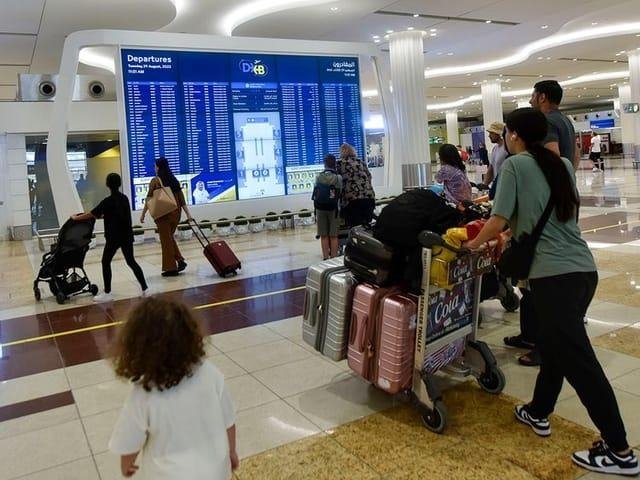
For UAE residents, the most immediate impact remains aviation. Emirates, Etihad Airways, flydubai and Air Arabia continue to operate services, but some flights have been delayed or cancelled as regional conditions remain uncertain.
At Dubai International Airport, several Emirates and flydubai services were affected, including cancellations involving Abha and Kochi. At Zayed International Airport in Abu Dhabi, an Air Arabia Abu Dhabi service to Sialkot was cancelled, while Etihad flights to Charlotte and Boston were delayed.
Airlines have stressed that disruptions can have different causes and are not necessarily all linked directly to regional security conditions. Passengers are therefore being urged to check their individual flight status before travelling to the airport.
Hormuz traffic shows limited recovery
The Strait of Hormuz remains central to the regional economic impact of the conflict.
Shipping and tanker-tracking data indicate that vessel traffic has begun to recover from extremely low levels. However, the increase in vessel movements has not yet translated into a return to normal oil flows.
Reuters reported that only four commodity vessels transited the strait on Monday, compared with 10 the previous day and a pre-war average of about 125 daily transits. The sharp reduction highlights the continuing pressure on one of the world’s most important energy corridors.
The difference between tanker movements and actual oil volumes is important. A gradual increase in ships does not necessarily mean energy exports have returned to normal.
For UAE households and businesses, prolonged disruption could continue to affect shipping costs, insurance premiums, supply chains and transport expenses.
Oil markets remain under pressure
Oil prices have remained elevated as traders assess the risk of further disruption to Gulf energy supplies.
Brent crude rose to about $106.93 a barrel on Tuesday after attacks affected Saudi Arabia’s East-West pipeline, according to Reuters. The pipeline provides an alternative route for Saudi oil exports that bypasses the Strait of Hormuz, making its disruption particularly significant for global supply concerns.
A prolonged interruption to alternative export routes could increase pressure on global oil markets and add to transport and energy costs.
Disputed tanker incident adds uncertainty
Another concern is the disputed incident involving the Panama-flagged crude tanker El Gaia.
Iran’s Islamic Revolutionary Guard Corps said the tanker exploded after hitting a naval mine in the Strait of Hormuz. US Central Command disputed that account, saying the vessel had previously been hit by an Iranian missile and later struck by a drone.
The conflicting accounts underline the uncertainty surrounding maritime incidents in and around Hormuz.
Any further attacks or restrictions could increase war-risk insurance costs and discourage commercial operators from using the waterway.
Diplomacy remains uncertain
The conflict is also being accompanied by competing diplomatic signals.
US President Donald Trump has said he remains open to engagement with Iran, while Washington continues to maintain pressure through military action and sanctions.
At the same time, Gulf states have postponed talks with Iran concerning the Strait of Hormuz, according to Reuters, reducing immediate expectations of a diplomatic breakthrough over the shipping route.
What UAE travellers should do
For residents planning to fly from Dubai, Abu Dhabi or Sharjah, the safest approach is to rely on the latest information from the airline rather than an earlier booking confirmation.
Travellers should:
- Check the airline’s website or app before leaving home.
- Allow additional time at the airport.
- Keep phones available for airline notifications.
- Check connecting flights separately.
- Be prepared for last-minute schedule changes.
The situation remains fluid, and flight schedules can change at short notice.
For UAE residents, the broader picture is one of continuing regional uncertainty rather than a return to normal. Hormuz traffic may be showing early signs of recovery, but shipping, energy markets and aviation remain exposed to further developments in the conflict.
What is happening in the Strait of Hormuz?
Tanker traffic is showing tentative signs of recovery, but commercial vessel movements and oil flows remain well below normal levels.
Are UAE flights operating?
Yes. Emirates, Etihad, flydubai and Air Arabia continue to operate services, although some flights have been delayed or cancelled.
Should UAE travellers check their flights before going to the airport?
Yes. Airlines advise passengers to check their individual flight status because schedules can change at short notice.
Are oil prices being affected by the conflict?
Yes. Brent crude has remained above $100 a barrel amid concerns about disruptions to Gulf energy supplies.
Why is the Strait of Hormuz important?
It is a major energy and shipping corridor, so disruption can affect oil supplies, shipping costs, insurance and global energy markets.
Are all UAE flight disruptions caused by the conflict?
No. The latest update notes that airlines and airports have cautioned that disruptions can have different causes.
