
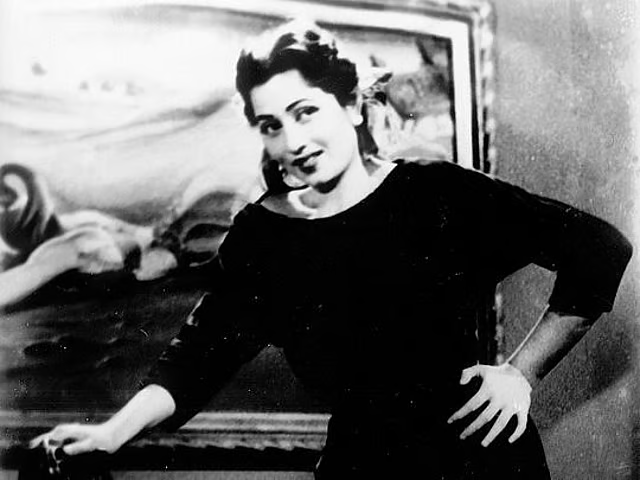
Madhubala remains one of Hindi cinema’s most enduring stars, but the story of her final resting place is less widely known. Her sister, Madhur Bhushan, has recalled how the family struggled to come to terms with the removal of the marble covering over the actress’s grave in Mumbai, believing for a time that little remained to identify it.
In an interview with entertainment journalist Vickey Lalwani, Bhushan described how their father, Ataullah Khan, continued visiting his daughter’s grave for years after her death in 1969. He had arranged for the grave to be covered in marble, creating a memorial that became deeply associated with the family’s efforts to honour the actress.
According to Bhushan, the structure was dismantled after Khan died in 1975. The family later learnt that the grave itself remained in the cemetery.
Why Madhubala’s marble memorial was removed
Bhushan said her father had covered the grave completely, including its top and sides. She explained that the arrangement differed from the customary practice she understood, in which the central portion of a grave was generally left unsealed.
After Khan’s death, the marble covering was broken up because, she recalled, the cemetery authorities said it could not remain in that form.
The loss left the family believing that the grave had become unrecognisable. Bhushan said she eventually learnt that it was still there and returned to the cemetery, where she was shown its location from a distance. She recalled that Madhubala’s name remained visible.
The distinction matters: the removal of a memorial does not necessarily mean that the burial site itself has disappeared. Bhushan’s account indicates that the family’s initial belief that no trace remained was later corrected.
A father who continued visiting his daughter’s grave
Madhubala died on February 23, 1969, aged 36, after years of health problems associated with a heart condition.
Bhushan has previously spoken about the effect her sister’s death had on their father. Despite his own serious health difficulties, including heart attacks and a stroke, Khan continued visiting the cemetery, according to her recollections.
She described him spending time beside the grave, sometimes bringing a chair and sitting there. The visits continued for years, reflecting the depth of his grief.
The marble memorial was particularly significant to the family because Khan had personally overseen its creation. In an earlier report published by The Economic Times on February 11, 2010, Bhushan said he had spent weeks and months at the cemetery working with artisans on the structure.
That report recorded the family’s objections when the memorial was dismantled. Bhushan questioned why the family had been permitted to build it if it was later going to be removed.
The wider controversy at Juhu Muslim cemetery
The dispute over Madhubala’s memorial formed part of a wider controversy concerning graves at Mumbai’s Juhu Muslim cemetery.
In February 2010, The Economic Times reported that memorials associated with several prominent figures, including Madhubala, singer Mohammed Rafi, composer Naushad and poet Sahir Ludhianvi, had been dismantled. The report said the cemetery had been levelled with additional soil to create space for further burials.
Cemetery representatives cited religious considerations and a shortage of burial space. Asgar Ali, then identified as president of the Muslim Majlis trust managing the burial ground, told The Economic Times that permanent memorial structures were not permitted under the interpretation followed by the trust. Its secretary, Qayyum Khan, also referred to the pressure on available space.
The issue involved competing concerns: families wanted to preserve the memorials of loved ones, while cemetery management maintained that the burial ground had to accommodate new burials under its rules and available capacity.
The controversy was not limited to Madhubala’s family. The Indian Express revisited the issue in September 2025 while reporting on the difficulty of identifying Mohammed Rafi’s grave after grave markers had been removed. The report cited the earlier dispute and described how the loss of visible markers had affected families and admirers.
These reports establish the historical controversy surrounding the cemetery. They do not, by themselves, establish the cemetery’s current management policies or the precise status of every grave today.
Madhubala’s legacy beyond the memorial
Born Mumtaz Jehan Begum Dehlavi, Madhubala became one of the defining stars of Hindi cinema. Her performances in films such as Mahal, Chalti Ka Naam Gaadi and Mughal-e-Azam helped secure her place in Indian film history.
Her role as Anarkali in Mughal-e-Azam, opposite Dilip Kumar, remains among her best-known performances. Her career, however, was cut short by serious illness, and she died before reaching 37.
The removal of the marble covering did not erase Madhubala’s name from cinema history. But her sister’s recollections show how the loss of a physical memorial can affect a family’s connection to a loved one’s final resting place.
For admirers who continue to remember Madhubala through her films, the story offers a different perspective on her legacy: one shaped not only by her performances and screen presence, but also by the family that sought to preserve her memory after her death.
1. What happened to Madhubala’s marble tomb?
According to her sister, Madhur Bhushan, the marble covering over Madhubala’s grave was dismantled after their father, Ataullah Khan, died in 1975. Bhushan later learnt that the grave itself remained in the cemetery.
2. When did Madhubala die?
Madhubala died on February 23, 1969, aged 36, after years of health problems associated with a heart condition.
3. Who was Madhur Bhushan?
Madhur Bhushan is Madhubala’s sister. She has shared family recollections about the actress’s life, illness, death and memorial.
4. Why was Madhubala’s marble memorial removed?
Bhushan said the marble covering was dismantled because cemetery representatives told the family that it could not remain in that form. In a separate controversy reported in 2010, cemetery management cited religious considerations and limited burial space as reasons for removing permanent memorial structures.
5. Where is Madhubala buried?
Madhubala was buried at Mumbai’s Juhu Muslim cemetery, also referred to in media reports as Juhu Muslim Kabristan.
6. Was Madhubala’s grave completely destroyed?
Bhushan’s account indicates that the marble covering was removed, but the grave remained. She said she later visited the cemetery and was shown the location, where Madhubala’s name was visible.
7. Why did Madhubala’s father visit her grave regularly?
According to Bhushan, Ataullah Khan was deeply affected by his daughter’s death and continued visiting her grave for years despite his own health problems.
8. Were other famous graves affected by the Juhu cemetery controversy?
Yes. A February 2010 report by The Economic Times identified memorials associated with Mohammed Rafi, Naushad and Sahir Ludhianvi among those dismantled at the cemetery. A later Indian Express report revisited the issue of missing grave markers.
