
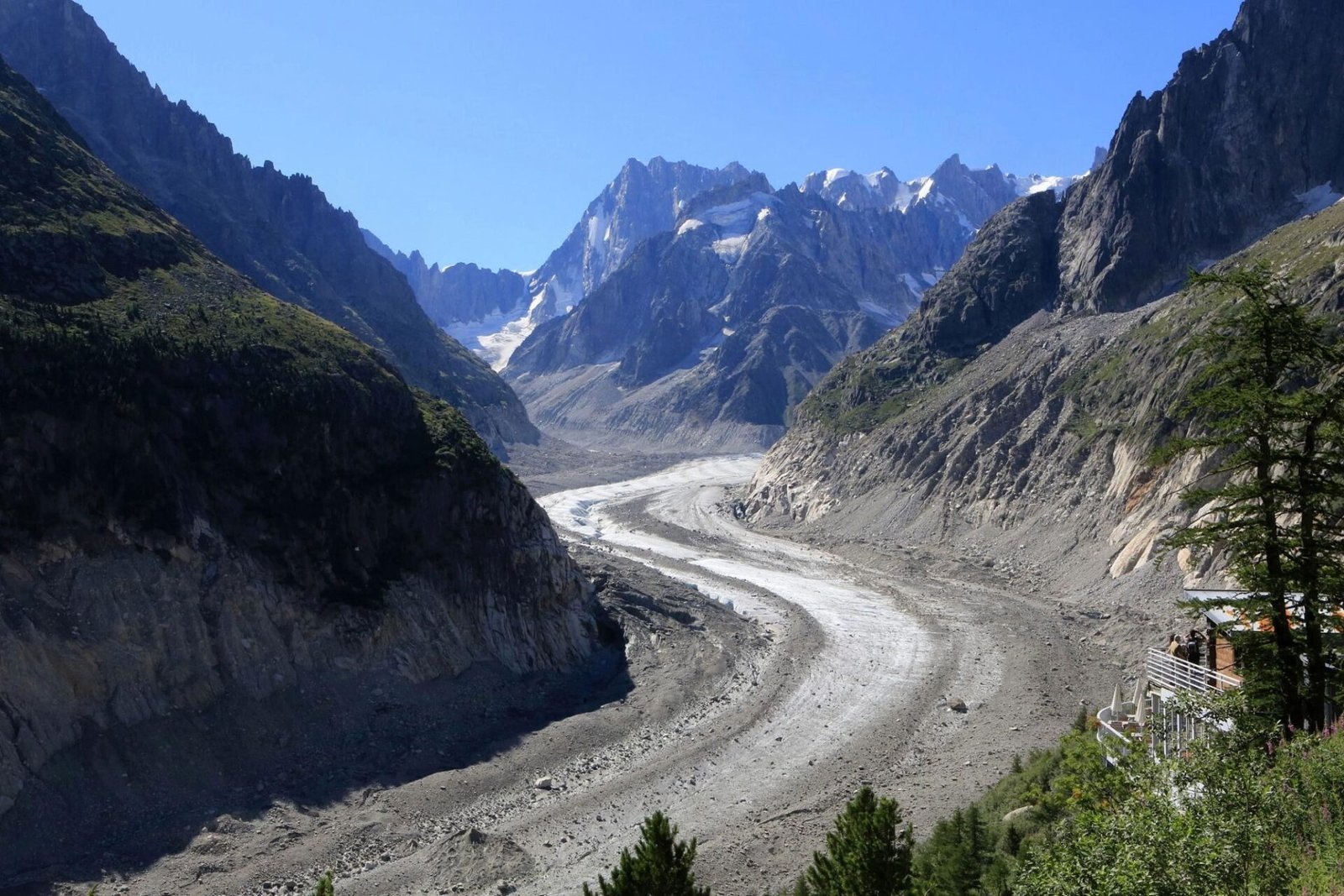
CHAMONIX-MONT-BLANC, France: One of France’s best-known glaciers is becoming a stark marker of the changing Alpine climate, with the Mer de Glace retreating while extreme summer heat is also destabilising parts of the surrounding mountain landscape.
The glacier, located above Chamonix in the Mont Blanc massif, has long been a major tourist attraction. But recent photographs from September 2026 show visitors looking over an increasingly altered landscape, while tarpaulins have been placed over sections of the glacier’s ice cave to slow melting.
The changes are not limited to the visible loss of ice. This summer’s high temperatures have also affected frozen ground at higher elevations. As Alpine permafrost thaws, rock faces can become less stable, increasing the risk of rockfalls and making some mountain routes more difficult or dangerous.
A glacier in long-term retreat
The Mer de Glace is one of the major glaciers of the French Alps. Data compiled by the International Union of Geological Sciences says the glacier and its main tributary covered about 28 square kilometres in 2022. Its ice flows from elevations above 4,000 metres down towards the Chamonix valley.
Long-term measurements show how substantial the transformation has been. Regional information on the Mont Blanc glaciers indicates that the Mer de Glace has lost about 50 metres of average ice thickness since the beginning of the 20th century, equivalent to roughly 32% of its average thickness.
Its front has also retreated considerably. The glacier’s snout has moved back more than 2.5 kilometres since the 18th century, with about 400 metres of retreat recorded over the past two decades, according to regional glacier information.
Extreme heat adds pressure
The glacier’s retreat is part of a wider transformation across the Alps. Climate warming is not only reducing glacier ice but also weakening frozen ground that helps stabilise high-altitude rock formations.
An Associated Press report from Chamonix said record heat this summer has contributed to the thawing of Alpine permafrost. The resulting instability has been linked to rockfalls and increasingly difficult conditions on routes around Mont Blanc.
Stéphane Bozon, a deputy mayor of Chamonix-Mont-Blanc responsible for safety, said the town has seen an increase in rockfalls and areas becoming harder to access as glaciers retreat and snow melts.
The risks are significant for mountaineers. Mont Blanc rises to 4,805 metres, and warming conditions can alter routes, expose crevasses and destabilise surrounding rock.
Tourism meets a changing glacier
Mer de Glace remains a major visitor attraction, accessible from Chamonix via the historic Montenvers railway and a cable car system leading towards the ice cave.
However, even the visitor experience is being affected by the glacier’s retreat. The official Chamonix tourism information says the Mer de Glace cable car operates during September 2026 but is scheduled to close from September 28 to October 16, while the ice cave is scheduled to remain closed from September 28 through November 1.
Protective coverings over the ice cave provide a striking visual reminder of the effort required to preserve an attraction that depends on frozen ice in a warming environment.
A wider warning for the Alps
France’s Ministry for Ecological Transition maintains long-term mass-balance data for several French Alpine glaciers, including Mer de Glace and Argentière. The ministry says glacier mass balance measures changes in a glacier’s volume and identifies the Institut des Géosciences de l’Environnement and the GLACIOCLIM programme as sources for the underlying data.
For communities around Mont Blanc, the issue is therefore larger than the disappearance of a familiar landscape. Glacier retreat, changing snow conditions and thawing permafrost can affect tourism, climbing routes and mountain safety.
The Mer de Glace continues to draw visitors, but the landscape they encounter is increasingly different from the one seen by previous generations.
What is happening to the Mer de Glace glacier?
The Mer de Glace is retreating and losing ice thickness as the Alpine climate warms. Long-term data show substantial loss of both glacier thickness and length.
Where is the Mer de Glace glacier?
It is located in the Mont Blanc massif above Chamonix-Mont-Blanc in the French Alps.
How much ice has the Mer de Glace lost?
Regional glacier data indicate that the glacier has lost about 50 metres of average thickness since the beginning of the 20th century, around 32% of its average thickness.
Why is the glacier shrinking?
Rising temperatures, particularly increasingly hot summers, are contributing to glacier ice loss. French government monitoring tracks the glacier through annual mass-balance measurements.
Is climate change affecting mountain safety around Mont Blanc?
Yes. Recent warming has contributed to permafrost thaw and rockfalls, while glacier retreat and snowmelt can expose crevasses and make some routes harder to access.
Can tourists still visit Mer de Glace in 2026?
Yes. The Montenvers railway and associated facilities continue to operate according to seasonal schedules, although the cable car and ice cave have specific closure periods in autumn 2026.
Where can visitors access the Mer de Glace?
The glacier is accessed from the Montenvers station above Chamonix, with the railway providing the main tourist connection.
