
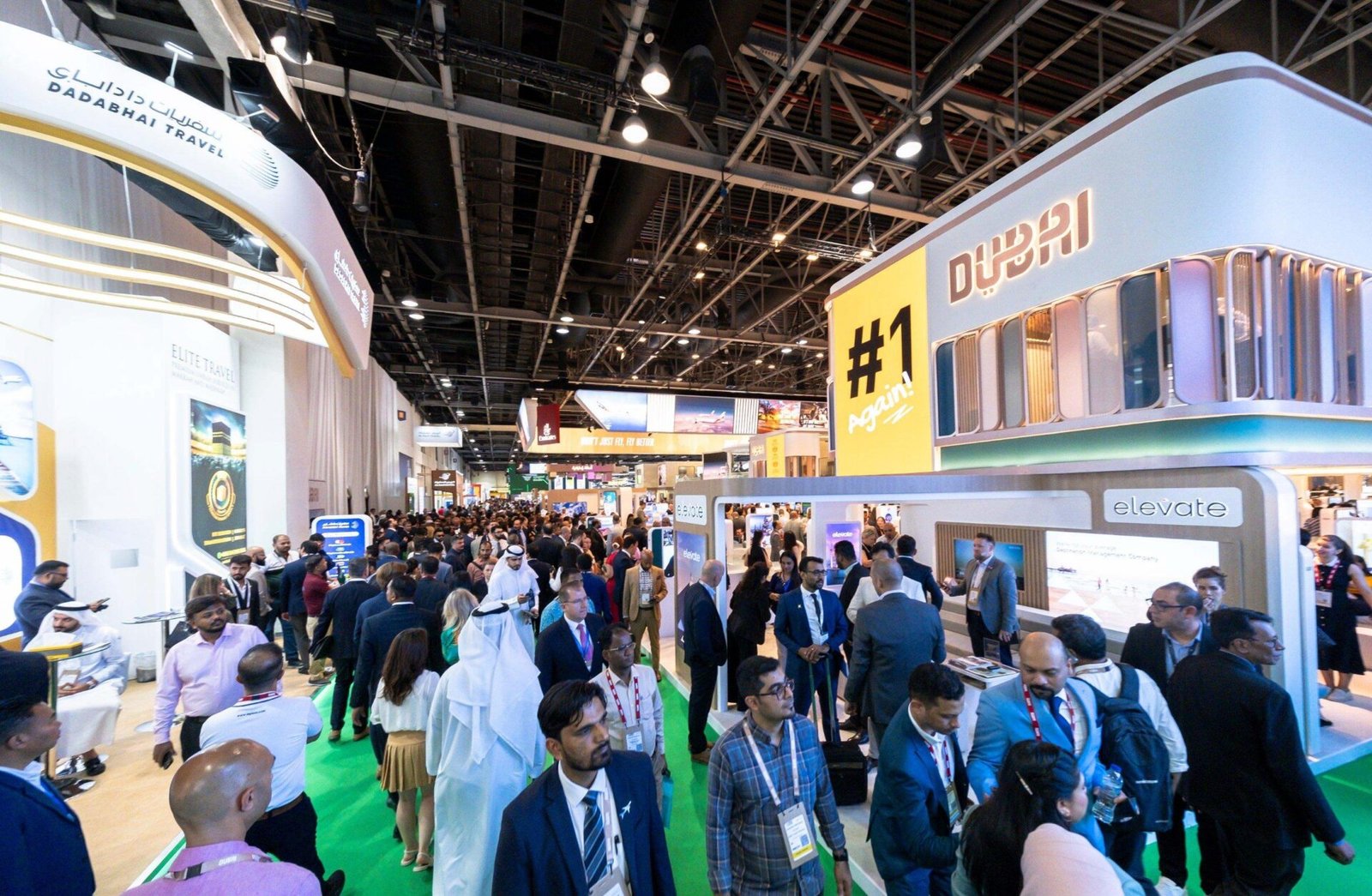
DUBAI: The UAE’s travel and tourism industry is entering a new phase after months of disruption, with Arabian Travel Market 2026 showing that airlines, airports, tourism authorities and hospitality operators are continuing to invest even as the market faces higher costs and uneven international demand.
The 33rd Arabian Travel Market, held at Dubai World Trade Centre from September 14 to 17, brought together travel companies, airlines, tourism authorities, hotels and technology providers from across the global industry. The event became a forum for assessing how quickly travel demand is returning and how the sector should prepare for longer-term growth.
One of the clearest messages from ATM 2026 was that Dubai’s aviation strategy is looking well beyond the current recovery.
Dubai prepares for a much larger aviation system
Dubai International Airport (DXB) handled 31.5 million passengers during the first half of 2026. Passenger traffic strengthened through the second quarter, reaching 5 million in June and 6.3 million in July. Dubai Airports expects DXB to handle about 70 million passengers for the full year.
That forecast remains significantly below the record 95.2 million passengers DXB handled in 2025. The decline reflects the disruption faced by the aviation sector during the first half of 2026 rather than a change in Dubai’s longer-term airport ambitions.
The longer-term expansion is centred on Al Maktoum International at Dubai World Central. Dubai Airports says the airport’s expansion plan involves a US$35 billion investment, with capacity planned to reach 150 million passengers annually within the next decade and eventually 260 million passengers and 12 million tonnes of cargo.
The shift is significant for Dubai’s tourism model because aviation capacity is closely tied to the emirate’s ability to attract international visitors and maintain its role as a major global connecting hub.
UAE airlines are restoring capacity
The recovery has also become visible among UAE carriers.
Emirates said it carried more than 8.6 million passengers during July and August and was operating at around 93 per cent of its pre-disruption capacity by September. The airline reported positive winter bookings across several markets, including Europe, India, Africa and the Americas.
The airline’s summer seat load factors remained healthy, while bookings for the winter season were showing stronger demand in several markets.
Etihad Airways has also been expanding its network and fleet, while flydubai has said it expects to return to full network capacity by the end of 2026, subject to the restoration of operating conditions.
The recovery, however, is not uniform across the global aviation market. Some international airlines continue to face operational restrictions and travel advisories connected with the wider regional security situation.
For UAE airlines, fuel costs remain another pressure point. Higher jet fuel prices can affect airline margins and, depending on market conditions, ticket pricing.
Dubai tourism numbers are recovering
Dubai’s hotel and visitor figures provide another indication of improving travel demand.
Dubai welcomed approximately 869,000 international overnight visitors in August 2026, its strongest monthly figure since February. International visitor numbers for the first eight months of the year reached approximately 6.97 million.
Hotel occupancy also improved sharply. Dubai’s hotel occupancy reached 66 per cent in August, compared with 36 per cent in March. The emirate had almost 149,000 hotel rooms by the end of August, while hotels recorded 21.61 million occupied room nights during the first eight months of the year.
The visitor mix remained diversified. Western Europe accounted for 20 per cent of visitors between January and August, followed by South Asia at 17 per cent, the GCC at 16 per cent, and CIS and Eastern Europe at 14 per cent.
That diversity gives Dubai multiple source markets rather than leaving the tourism sector dependent on one region.
UAE emirates broaden their tourism offering
ATM 2026 also highlighted efforts to develop tourism beyond Dubai’s established city, luxury and shopping proposition.
Ras Al Khaimah is continuing to develop adventure and outdoor tourism, including plans around the Jebel Jais area. Sharjah is also investing in experience-led attractions, including projects around Al Faya.
The wider strategy is to create more reasons for visitors to explore different parts of the UAE and potentially extend their stays.
For the UAE tourism industry, that means growth is increasingly being pursued through a wider network of destinations, attractions and experiences rather than relying only on established tourism centres.
AI moves from concept to practical tourism tool
Technology was another major theme at ATM 2026.
The event’s theme, “Travel 2040: Driving New Frontiers Through Innovation and Technology,” placed artificial intelligence, digitalisation and smart mobility at the centre of discussions about the industry’s future.
Industry discussions increasingly focused on practical applications of AI, including travel planning, personalisation, destination management, airline operations and hotel services.
At an ATM executive roundtable, travel-sector leaders also stressed that technology investment needs to be matched with skilled employees and customer-focused service.
That distinction is becoming important as tourism companies adopt AI without removing the human element of hospitality.
What comes next for UAE tourism?
The immediate recovery in aviation and tourism provides a stronger base for the UAE’s longer-term expansion plans, but the industry still faces variables outside the direct control of tourism authorities and operators.
Fuel prices, international travel advisories, airline capacity and traveller confidence will influence how quickly demand returns across different markets.
At the same time, the UAE is continuing to add airport capacity, expand airline networks, develop new tourism destinations and invest in technology.
ATM 2026 therefore offered a picture of a sector dealing with short-term uncertainty while continuing to build for a substantially larger travel market in the years ahead.
What is ATM 2026?
ATM 2026 is the 33rd edition of Arabian Travel Market, an international travel and tourism industry event held at Dubai World Trade Centre from September 14 to 17, 2026.
What were the main themes at ATM 2026?
Key themes included aviation recovery, tourism growth, travel technology, artificial intelligence, destination development and rebuilding confidence across the international travel industry.
How many passengers is DXB expected to handle in 2026?
Dubai Airports expects Dubai International Airport to handle around 70 million passengers in 2026.
How many passengers did DXB handle in 2025?
DXB handled a record 95.2 million passengers in 2025, its busiest year on record.
How is Dubai tourism performing in 2026?
Dubai recorded approximately 6.97 million international overnight visitors during the first eight months of 2026, including around 869,000 visitors in August.
How is Emirates performing after the disruption?
Emirates reported carrying more than 8.6 million passengers during July and August 2026 and operating at about 93 per cent of its pre-disruption capacity.
What is planned for Al Maktoum International Airport?
Dubai’s expansion plans for Al Maktoum International involve a US$35 billion investment. Capacity is planned to reach 150 million passengers annually within the next decade, with an eventual capacity of 260 million passengers and 12 million tonnes of cargo.
What role is AI expected to play in tourism?
AI is increasingly being used and discussed for travel planning, personalisation, airline operations, destination management and hotel services, alongside human expertise and customer service.
