
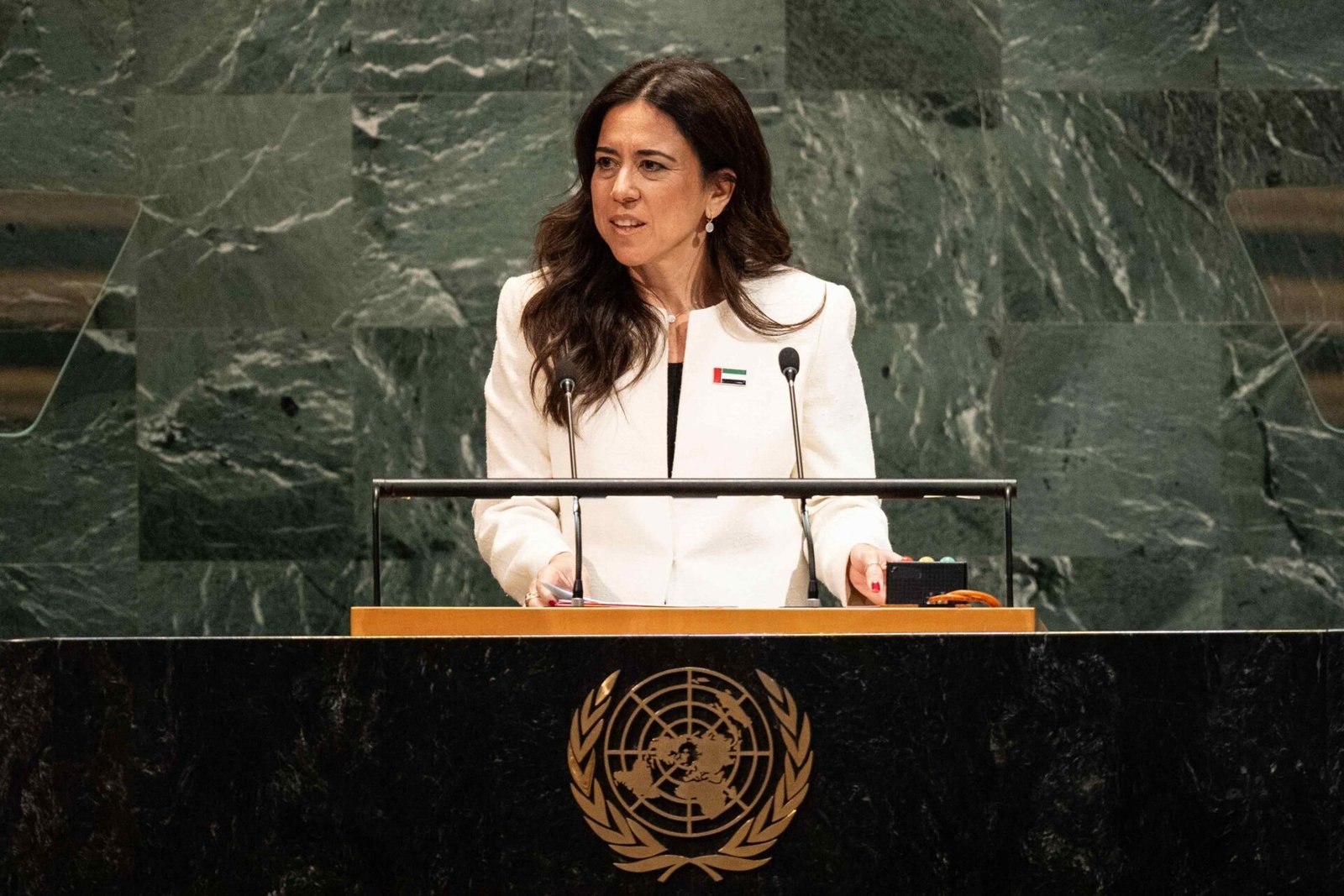
The UAE has formally nominated Lana Zaki Nusseibeh, its Minister of State, to become the next Secretary-General of the United Nations, bringing an experienced Emirati diplomat into the contest to lead the international organisation from January 2027.
The nomination was submitted by UAE President Sheikh Mohamed bin Zayed Al Nahyan in a letter to the presidents of the UN General Assembly and Security Council, according to the UAE’s state news agency, WAM. Nusseibeh has previously represented the UAE at the United Nations for more than a decade and held senior positions within its principal diplomatic bodies.
Her candidacy comes as UN member states consider who should replace António Guterres, whose second and final term ends on December 31, 2026. The next Secretary-General will face the task of navigating international conflicts, divisions among major powers and pressure for the organisation to deliver more effective results.
An experienced Emirati diplomat enters the race
Nusseibeh served as the UAE’s Permanent Representative to the United Nations from 2013 to 2024. During that period, she represented the country through its 2022–2023 term as an elected member of the Security Council and twice served as the council’s president. She also served as a vice-president of the General Assembly and led the Executive Board of UN Women.
Her diplomatic portfolio has included peace and security, humanitarian action, sustainable development and reform of multilateral institutions. Reuters reported that her work at the UN included efforts connected to Security Council Resolution 2720, adopted in December 2023 to support humanitarian aid deliveries to Gaza.
That background gives Nusseibeh experience in negotiations involving governments with competing interests. However, previous senior diplomatic roles do not guarantee support in the selection process, where the positions of the Security Council’s permanent members are decisive.
What Nusseibeh wants to change at the UN
Nusseibeh’s published vision places conflict prevention and practical diplomacy at the centre of her proposed leadership approach. Her programme calls for the UN to help parties find workable agreements, protect channels for negotiations and improve humanitarian access in areas affected by conflict.
She also proposes changes to how the organisation operates. These include reducing duplication between programmes, setting clearer priorities, strengthening accountability for spending and results, and giving officials working in the field greater capacity to respond to problems.
On development, her proposals include placing employment and national development priorities closer to the centre of international cooperation. Her vision also addresses human rights, climate-related risks and international cooperation on emerging technologies, including artificial intelligence and biotechnology.
The programme will be tested against the expectations of the countries that ultimately determine the appointment. The Secretary-General must lead an organisation whose 193 member states do not always agree on conflicts, security priorities or the limits of international intervention.
How the next UN chief will be selected
The Secretary-General is appointed by the General Assembly on the recommendation of the Security Council. This means a candidate must secure sufficient support in the 15-member council, including avoiding a veto by any of its five permanent members: China, France, Russia, the United Kingdom and the United States.
The council has been assessing candidates through informal straw polls. Reuters reported on October 21 that Costa Rica’s Rebeca Grynspan had been the narrow frontrunner in the latest round, held on October 16, but that candidates had also faced opposition from permanent members.
Those informal ballots are part of the effort to identify a candidate capable of attracting broader agreement. They are not the final appointment, and the outcome remains dependent on negotiations among member states.
Nusseibeh’s entry therefore adds another option to a process in which diplomatic acceptability matters alongside experience and a candidate’s policy agenda.
What the appointment could mean for the UAE
For the UAE, the nomination places one of its most experienced multilateral diplomats in contention for the UN’s highest executive post. It also brings the country’s diplomatic priorities into a leadership contest focused on the future direction of the organisation.
If elected, Nusseibeh would become the first woman to serve as UN Secretary-General, a position that has been held by men since the organisation was founded in 1945. She would also be the second Secretary-General from the Middle East, following Egypt’s Boutros Boutros-Ghali, who held the post from 1992 to 1996.
Neither outcome is assured. Her candidacy must still pass through the Security Council’s recommendation process before the General Assembly can appoint a successor.
For now, the UAE’s nomination marks the start of a further round of diplomacy over who will lead the United Nations into 2027 and how the organisation should respond to a period of sustained international tension.
Q1. Who is Lana Nusseibeh?
Lana Zaki Nusseibeh is a UAE Minister of State and diplomat who served as the UAE’s Permanent Representative to the United Nations from 2013 to 2024. She has held several senior positions within UN bodies.
Q2. Has the UAE nominated Lana Nusseibeh for UN Secretary-General?
Yes. The UAE formally nominated Nusseibeh in October 2026, with President Sheikh Mohamed bin Zayed Al Nahyan submitting the nomination to the presidents of the UN General Assembly and Security Council.
Q3. When does António Guterres’s term end?
António Guterres’s second term as UN Secretary-General ends on December 31, 2026. His successor is expected to take office in January 2027.
Q4. How is the UN Secretary-General chosen?
The 15-member Security Council recommends a candidate to the General Assembly. The recommendation must avoid a veto from any of the five permanent members: China, France, Russia, the United Kingdom and the United States. The General Assembly then makes the appointment.
Q5. Could Lana Nusseibeh become the first woman UN Secretary-General?
Yes. If elected, she would be the first woman to hold the position since the United Nations was founded in 1945. Her election is not guaranteed, as she must secure the necessary support through the selection process.
Q6. What experience does Lana Nusseibeh bring to the role?
She served as the UAE’s UN ambassador from 2013 to 2024, twice presided over the Security Council during the UAE’s 2022–2023 membership and held leadership roles in the General Assembly and UN Women.
Q7. What are Nusseibeh’s priorities for the United Nations?
Her published vision emphasises conflict prevention, diplomacy, humanitarian access, institutional reform, accountability, sustainable development and international cooperation on emerging technologies.
Q8. Who will decide the next UN Secretary-General?
The UN Security Council will recommend a candidate, and the General Assembly will make the appointment. The outcome depends on the council’s voting process and negotiations among member states.
