
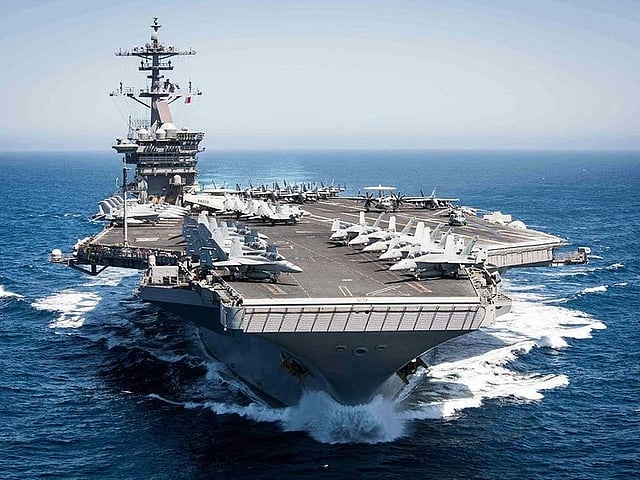
The United States has strengthened its military presence in the Middle East after the USS Theodore Roosevelt aircraft carrier strike group entered the US Central Command’s area of responsibility on Sunday, November 15, bringing the number of American carrier strike groups in the region to three.
The arrival places the USS Theodore Roosevelt alongside the USS George H.W. Bush and USS George Washington, both already operating in the region. The development comes amid an increasingly fragile confrontation between Washington and Tehran, with military pressure, maritime security concerns and stalled diplomatic efforts keeping the region on edge.
A US military official confirmed the Roosevelt’s arrival to multiple news organisations, including ABC News and The National. The deployment is also part of a wider American naval presence supporting operations connected to the blockade of Iranian ports.
## Which US aircraft carriers are now in the region?
The three carrier strike groups are led by:
– **USS Theodore Roosevelt:** The Nimitz-class nuclear-powered aircraft carrier that entered the CENTCOM area on November 15.
– **USS George H.W. Bush:** One of the two American carriers already operating in the region.
– **USS George Washington:** The other carrier deployed in the wider Middle East operational area.
A carrier strike group is more than an aircraft carrier. It typically includes guided-missile destroyers, cruisers, aircraft and other supporting vessels. These ships provide protection, surveillance and additional military capabilities.
According to reporting by ABC News, the three carrier groups are among more than 20 US Navy ships involved in enforcing the blockade of Iranian ports.
The deployment does not necessarily mean all three carriers will remain in the region for an extended period. The USS George Washington had initially been expected to be relieved by the Roosevelt, but both remained within the CENTCOM area after the latter’s arrival.
This raises an important question about whether Washington intends to maintain three carrier groups simultaneously or whether the current arrangement is part of a temporary rotation.
## Why has the US increased its naval presence?
The carrier’s arrival comes after months of confrontation between the United States and Iran.
Washington has continued applying military and economic pressure on Tehran, including restrictions on Iranian maritime trade. The naval presence gives the US additional capacity to monitor shipping routes, support maritime enforcement and maintain military readiness.
The deployment also provides Washington with more operational flexibility should the confrontation deteriorate further.
However, the movement of additional military assets should not automatically be interpreted as confirmation of an imminent attack.
A November 15 assessment by Israel’s Institute for National Security Studies (INSS) described the Roosevelt as approaching the region and raised the possibility that its deployment could be a rotation rather than a permanent increase in the number of carriers.
The same assessment identified two carriers already operating in the CENTCOM area before the Roosevelt’s arrival, alongside destroyers and other naval vessels.
## Iran-US tensions intensify as Bahrain reports attacks
The carrier deployment coincides with renewed security concerns across the Gulf.
Bahrain reported intercepting Iranian attacks on November 15, while Iran’s Islamic Revolutionary Guard Corps claimed to have launched drones towards a US military facility in the country.
Reuters reported that the IRGC described the operation as retaliation for US actions. Bahrain, meanwhile, said incoming munitions had been intercepted.
The incident adds to concerns about the possibility of military exchanges spreading beyond Iranian territory and involving locations hosting American military personnel.
Bahrain is particularly important to US regional operations because it hosts the headquarters of the US Navy’s Fifth Fleet.
For Gulf countries, the security situation is closely connected to the protection of military installations, energy infrastructure, commercial shipping and critical transport routes.
## Tehran warns against another US attack
Diplomatic tensions have also continued alongside the military developments.
Iranian Deputy Foreign Minister Kazem Gharibabadi said on November 15 that Tehran would not wait for the United States to launch another attack before responding.
Speaking to Iran’s state news agency IRNA, Gharibabadi questioned Washington’s intentions in negotiations and suggested that diplomatic discussions could be used to prepare for further military action.
His remarks indicate how difficult it may be to restore confidence between the two governments while military deployments and security warnings continue.
Meanwhile, Reuters reported on November 14 that US President Donald Trump had told advisers he might hold off on further attacks against Iran unless Tehran or Iran-backed Houthis provoked Washington.
The report also said regional leaders, including Saudi Crown Prince Mohammed bin Salman and Turkish President Recep Tayyip Erdogan, had urged restraint during discussions with Trump.
These developments suggest that Washington is maintaining military options while the possibility of renewed diplomacy remains open.
## What the third carrier means for Gulf security
The arrival of another American carrier strike group is significant for the wider Gulf because the region is central to international energy supplies and maritime trade.
The Strait of Hormuz, located between Iran and Oman, is one of the world’s most important oil transit routes. Any prolonged disruption to shipping through the waterway could affect energy markets, freight costs and international supply chains.
For the UAE, regional developments involving Iran, American military forces and Gulf maritime security deserve close attention.
Dubai and Abu Dhabi are major international business and transport centres, while UAE companies operate across industries that depend on stable regional trade and logistics networks.
An escalation could increase uncertainty for shipping operators, airlines, energy markets and businesses with exposure to the wider Middle East.
However, the arrival of the USS Theodore Roosevelt does not, by itself, establish that UAE airspace, airports or commercial shipping routes are facing new restrictions.
Travellers and residents should rely on official UAE government announcements, airline communications and relevant aviation and maritime authorities for verified operational information.
## What happens next?
The immediate question is whether the United States will maintain all three carrier strike groups in the CENTCOM area or return to a two-carrier deployment after completing a rotation.
The next developments will also depend on the direction of US-Iran diplomacy, the security situation in Bahrain and other Gulf locations, and any further action affecting maritime traffic.
For now, the Roosevelt’s arrival demonstrates that Washington is keeping substantial naval capabilities available in the region. Whether that presence becomes a platform for further military action or remains part of a wider pressure strategy will depend on decisions that have yet to be announced.
The reporting distinction matters here: the carrier’s arrival was confirmed by a US official to several news organisations, but there was no public confirmation that its arrival meant an imminent new attack on Iran.
Q1. What happened with the third US aircraft carrier?
The USS Theodore Roosevelt entered the US Central Command area of responsibility on November 15, 2026. It joined the USS George H.W. Bush and USS George Washington.
Q2. Which three US aircraft carriers are in the Middle East?
They are the USS Theodore Roosevelt, USS George H.W. Bush and USS George Washington.
Q3. Why did the USS Theodore Roosevelt arrive in the region?
Its deployment strengthens the US naval presence and supports American military operations in the wider region. Its arrival may also form part of a carrier rotation.
Q4. Does the third aircraft carrier mean the US will attack Iran?
No. The deployment does not confirm that an attack is imminent. Washington has not publicly announced a decision to launch another military campaign.
Q5. How has Iran responded to the US military deployment?
Iranian officials have issued warnings against further US attacks. Deputy Foreign Minister Kazem Gharibabadi said Tehran would not necessarily wait for Washington to strike first.
Q6. Is Bahrain involved in the latest Iran-US tensions?
Yes. Bahrain reported intercepting Iranian attacks on November 15, while Iran’s Revolutionary Guard claimed it had launched drones towards a US military facility there.
Q7. Could the US-Iran conflict affect the UAE?
A wider escalation could create risks for regional maritime trade, energy markets, aviation and business confidence. However, the carrier’s arrival alone does not establish any new restrictions affecting the UAE.
Q8. What is the CENTCOM area of responsibility?
CENTCOM is the US military command responsible for operations across the Middle East and several surrounding regions. Its area of responsibility is a military command region, not a reference to one specific country.
