
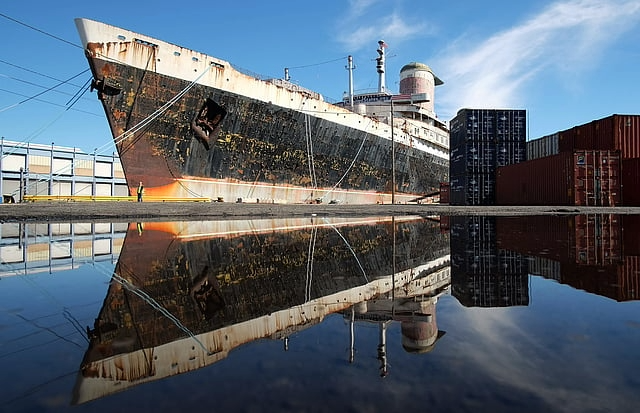
The historic SS United States has completed its final voyage, settling beneath the Gulf of Mexico off Florida on November 11, 2026, after being deliberately sunk to create what organisers describe as the world’s largest artificial reef.
The 990-foot (302-metre) former ocean liner was deployed approximately 22 nautical miles southwest of Destin-Fort Walton Beach. Once celebrated for its speed and engineering, the vessel is now expected to provide an underwater habitat for marine organisms and become a new attraction for scuba divers and fishing enthusiasts.
The sinking also marks the beginning of a scientific research project. Marine researchers will monitor how organisms colonise the ship and how an ecosystem develops around a large artificial structure over time.
A historic ocean liner takes its final journey
The SS United States was launched in 1952 and became one of the most recognisable passenger ships of its era. It set a transatlantic speed record during its maiden voyage, a record that remains unmatched by an ocean liner.
During 17 years of commercial passenger service, the vessel completed more than 800 Atlantic crossings between the United States and Europe.
Its passenger list included prominent political figures and entertainment personalities. Former US presidents Harry Truman, Dwight Eisenhower and John F. Kennedy travelled aboard the ship, alongside Hollywood names including Cary Grant, Judy Garland and Marlon Brando.
However, the growth of commercial aviation changed the economics of long-distance passenger shipping. The SS United States was retired in 1969, ending its relatively short career at sea.
The ship subsequently passed through several ownership arrangements as attempts to preserve it as a museum, hotel or visitor attraction failed to secure a lasting solution. It remained docked in Philadelphia for nearly three decades before being moved to Mobile, Alabama, in February 2025 for preparation ahead of its conversion into an artificial reef.
Why Florida chose to turn the ship into an artificial reef
The project was organised by Okaloosa County in Florida, which purchased the vessel in 2024 for approximately $1 million.
Rather than dismantling the entire ship for scrap, the county pursued a plan to transform it into an offshore marine habitat. The wider project, including preparation and deployment, has been estimated at around $13.5 million.
Artificial reefs are underwater structures that provide surfaces and spaces where marine organisms can settle, grow and find shelter. They can attract fish and other marine species, while also creating locations for recreational diving and fishing.
The SS United States offers an unusually large structure for this purpose. Its steel framework, internal spaces and prepared passageways are expected to provide different environments for marine life as the reef develops.
Before the sinking, specialist crews carried out extensive preparation. Residual fuel and environmentally unsafe materials were removed, along with items that could create entanglement risks for divers. Openings were cut into the hull and decks to allow controlled flooding and provide access for marine organisms.
The operation was designed to take place without explosives.
Scientists will monitor how marine life develops around the wreck
One of the project’s most important aspects extends beyond tourism.
The Woods Hole Oceanographic Institution (WHOI) announced that its researchers would use the SS United States reef as a scientific research site to observe how an ecosystem develops from the beginning.
The research will examine changes in water chemistry, microbial activity and biological communities surrounding the vessel.
Marine biologists will document the early stages of colonisation, tracking how organisms establish themselves on the ship and how environmental conditions change as the structure becomes part of the underwater ecosystem.
According to WHOI, researchers plan to collect water samples from 132 locations around the vessel to measure selected elements and compounds, including metals associated with the natural corrosion of steel structures.
The findings could help scientists understand how artificial structures influence marine biodiversity and how future reef projects can be designed to support underwater ecosystems.
Researchers also plan to revisit the site annually to collect samples and photograph changes. A possible citizen-science programme could eventually allow recreational divers to contribute photographs to the research database.
The project involves researchers from WHOI, with additional microbiological work led by a scientist from the University of Southern Mississippi.
What the new reef means for divers and fishing tourism
The wreck is expected to rest approximately 180 feet (55 metres) below the surface of the Gulf of Mexico, with its upper decks around 50 feet beneath the water.
This positioning could make parts of the vessel accessible to recreational scuba divers, although the depth of the wreck means that divers will need to consider their certification, training and experience.
The location, southwest of Destin-Fort Walton Beach, will add another major site to an established artificial reef network in Florida’s Panhandle.
The region already has more than 500 artificial reef sites created using vessels and other underwater structures. The SS United States is expected to become a particularly prominent addition because of its size and historical importance.
Its arrival could strengthen the area’s appeal among wreck divers, underwater photographers and fishing enthusiasts. However, the timing of wider recreational access will depend on operational arrangements and relevant safety guidance.
The ship’s history will also be preserved on land
Although the vessel itself now rests underwater, parts of its heritage have been retained.
Its distinctive funnels, radar mast, anchor and other selected components were removed before deployment and reserved for a planned land-based museum in the Destin-Fort Walton Beach area.
The SS United States Conservancy is working with Okaloosa County on the museum project. The proposed attraction is intended to preserve the ship’s design, engineering and role in American maritime history.
The museum will provide an opportunity for visitors who cannot explore the underwater wreck to learn about the vessel’s past.
For a ship that once represented American engineering ambition and transatlantic travel, its final transformation creates two separate legacies: an underwater structure intended to support marine life and a collection of historical artefacts that will continue telling its story on land.
Q1. What happened to the SS United States?
The historic SS United States was deliberately sunk on November 11, 2026, off Florida’s Gulf Coast. It is being converted into the world’s largest artificial reef.
Q2. Where was the SS United States sunk?
The vessel was sunk approximately 22 nautical miles southwest of Destin-Fort Walton Beach, Florida, in the Gulf of Mexico.
Q3. How big is the SS United States?
The historic ocean liner measures approximately 990 feet (302 metres) in length.
Q4. Why was the SS United States sunk?
Okaloosa County acquired the ship to transform it into an artificial reef. The project aims to create marine habitat while supporting recreational diving, fishing and scientific research.
Q5. How deep is the SS United States artificial reef?
The vessel is expected to rest approximately 180 feet (55 metres) below the surface, with its upper decks around 50 feet underwater.
Q6. Can divers explore the SS United States wreck?
The site is being prepared as a diving destination, but recreational access depends on safety arrangements and operational guidance. Divers should check with authorised local operators before planning a visit.
Q7. Will the sinking of the SS United States be studied by scientists?
Yes. Researchers from the Woods Hole Oceanographic Institution will study water chemistry, microbial activity and the development of marine communities around the wreck.
Q8. What happened to the historic parts of the SS United States?
Selected components, including its funnels, radar mast and anchor, were removed before the sinking. They are intended to form part of a planned museum in the Destin-Fort Walton Beach area.
