
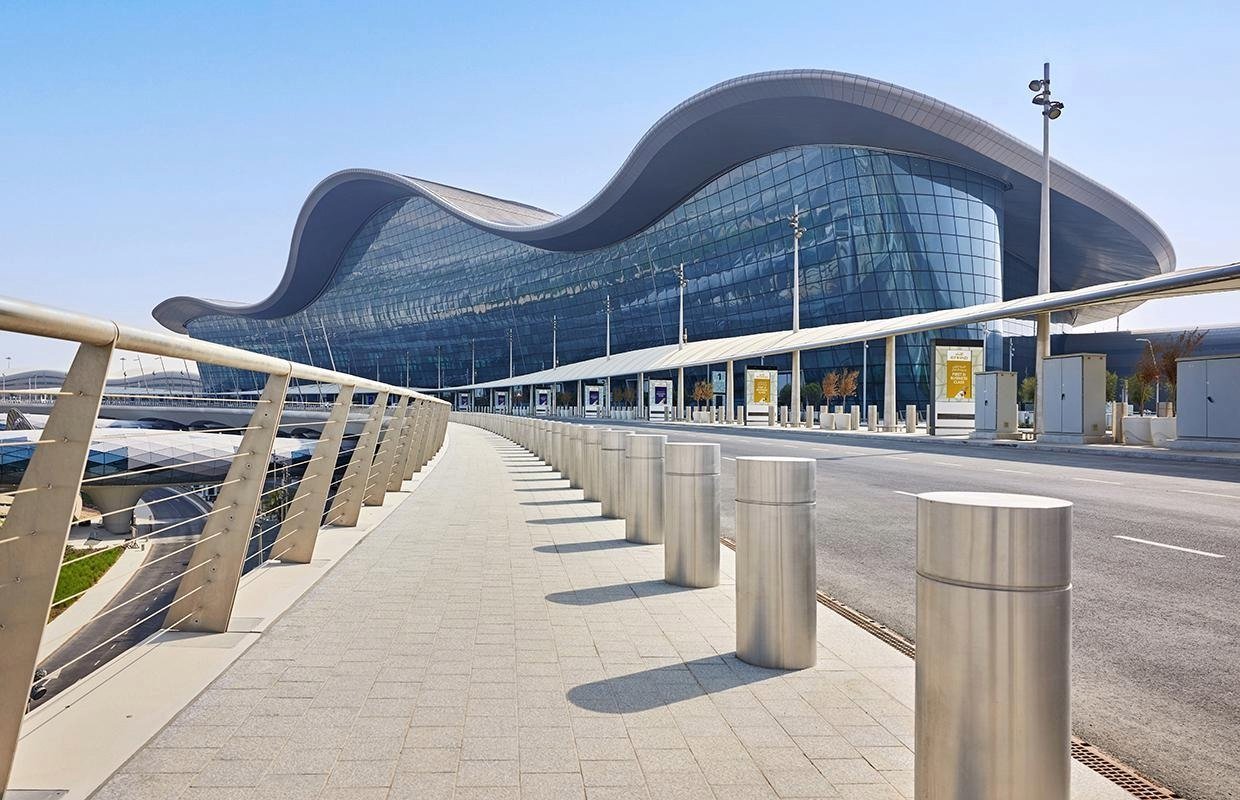
Abu Dhabi’s aviation industry has travelled a long way from the small airstrip that handled the capital’s first commercial flights in 1955 to Zayed International Airport, which recorded 32.5 million passengers in 2025.
The airport’s evolution reflects the growth of Abu Dhabi itself. What began with limited regional air services has developed into an international gateway supporting passenger travel, tourism and commercial connections across multiple markets.
Today, Zayed International Airport serves more than 100 destinations through a network of international airlines. Its Terminal A, which became fully operational in November 2023, has an annual passenger capacity of up to 45 million.
Abu Dhabi’s first commercial flights
Commercial aviation in Abu Dhabi began in 1955, when aircraft used a modest airstrip and a basic terminal and control facility. The early services were limited compared with the international network available to travellers today.
Historical accounts published by The National describe Gulf Aviation operating small De Havilland Dove aircraft on services from Bahrain, with stops that included Sharjah. These flights connected Abu Dhabi to the region at a time when its aviation infrastructure was still in its infancy.
The early airfield represents the starting point of a much broader transformation. As the capital expanded, its requirements for passenger transport and international connectivity grew, creating demand for larger and more capable airport facilities.
From Al Bateen to the modern airport
Al Bateen became an important part of Abu Dhabi’s aviation development. The airport, located on Abu Dhabi Island, served as a key aviation facility before the opening of the capital’s present international airport.
Abu Dhabi International Airport was inaugurated at its current location in 1982. The new facility marked a major change in the scale of the capital’s aviation infrastructure, providing a foundation for further expansion as passenger numbers and airline operations increased.
The former airport site subsequently developed into Al Bateen Executive Airport, which now serves business aviation, private aircraft and official delegations.
Abu Dhabi’s aviation network also expanded beyond its main passenger gateway. Abu Dhabi Airports, established in 2006, now operates five airports in the emirate, including Zayed International Airport, Al Bateen Executive Airport, Tahnoun International Airport, Delma Island Airport and Sir Bani Yas Island Airport.
Etihad Airways and airport expansion
The establishment of Etihad Airways in 2003 added another important dimension to Abu Dhabi’s aviation development. The airline strengthened the capital’s international connections and became closely associated with the growth of its main airport.
As operations expanded, additional infrastructure was introduced to accommodate demand. Terminal 2 opened in 2005, followed by a second runway in 2008 and Terminal 3 in 2009.
These developments helped the airport manage a growing range of airline operations and passenger journeys. They also preceded the construction of a much larger terminal designed to support the next stage of Abu Dhabi’s international aviation ambitions.
Terminal A changes the scale of operations
Terminal A began welcoming passengers in November 2023 and became fully operational on November 15 that year. The facility was subsequently incorporated into the airport’s identity when Abu Dhabi International Airport was renamed Zayed International Airport on February 9, 2024.
The terminal covers approximately 742,000 square metres and was designed to handle up to 45 million passengers annually. Its X-shaped design incorporates four piers, with passenger facilities and technology intended to support the movement of travellers through the airport.
The new terminal also provides space for a broader mix of retail, dining and passenger services. Its capacity is intended to give Abu Dhabi room to accommodate additional airline services and future passenger growth.
The airport’s new name honours the UAE’s Founding Father, the late Sheikh Zayed bin Sultan Al Nahyan. The renaming was announced at an official ceremony in February 2024, with the airport’s visual identity drawing on elements of Emirati heritage and Abu Dhabi’s landscape.
Passenger traffic reaches a new high
The scale of the transformation is reflected in the airport’s latest reported traffic figures.
According to Abu Dhabi Airports, Zayed International Airport handled a record 32.5 million passengers in 2025, an increase of 12.6% compared with 2024. Across the operator’s five airports, annual passenger traffic exceeded 33 million for the first time.
The airport also expanded its route network during 2025. Abu Dhabi Airports reported 39 route launches and the addition of seven airlines during the year, strengthening links to markets across Europe, the Middle East, Asia and beyond.
The figures show how the airport’s role has changed since the early days of commercial aviation in Abu Dhabi. Its operations now extend beyond serving travellers arriving in or departing from the capital to include connecting passengers moving between international destinations.
What the airport’s growth means for Abu Dhabi
International air connectivity is an important part of Abu Dhabi’s tourism and business infrastructure. A larger airport and a wider airline network can provide travellers with more route options while supporting access to hotels, attractions, business districts and other destinations across the emirate.
Airport operations also contribute to the movement of goods. Abu Dhabi Airports reported that nearly 770,000 tonnes of cargo passed through its five-airport network in 2025, up 12% year on year.
Capacity remains central to the airport’s longer-term plans. Abu Dhabi Airports has outlined an ambition to increase Zayed International Airport’s annual passenger capacity to 65 million by 2035, subject to the infrastructure development required to support that target.
From the first commercial air services in 1955 to a modern airport handling tens of millions of passengers each year, Abu Dhabi’s aviation history provides a clear measure of how far the capital’s transport infrastructure has developed. The next phase will depend on how effectively the airport expands its capacity, airline network and services as international travel demand evolves.
Q1. When did commercial aviation begin in Abu Dhabi?
Commercial air services began in Abu Dhabi in 1955, operating from a small airstrip and basic airport facilities.
Q2. When did Abu Dhabi International Airport open at its current location?
The airport at its current location was inaugurated in 1982. It was later renamed Zayed International Airport in honour of Sheikh Zayed bin Sultan Al Nahyan.
Q3. When was Abu Dhabi International Airport renamed Zayed International Airport?
The new name took effect on February 9, 2024, during an official naming and brand-reveal ceremony.
Q4. When did Terminal A open at Zayed International Airport?
Terminal A began receiving passengers in November 2023 and became fully operational on November 15, 2023.
Q5. How many passengers did Zayed International Airport handle in 2025?
Zayed International Airport handled a record 32.5 million passengers in 2025, according to Abu Dhabi Airports.
Q6. What is Terminal A’s annual passenger capacity?
Terminal A was designed to accommodate up to 45 million passengers annually.
Q7. Which airline is based at Zayed International Airport?
Etihad Airways, the UAE’s national airline, is based at Zayed International Airport in Abu Dhabi.
Q8. What is the planned passenger capacity of Zayed International Airport by 2035?
Abu Dhabi Airports has outlined a plan to increase annual passenger capacity to 65 million by 2035. This is a future target, not the airport’s current operating capacity.
