
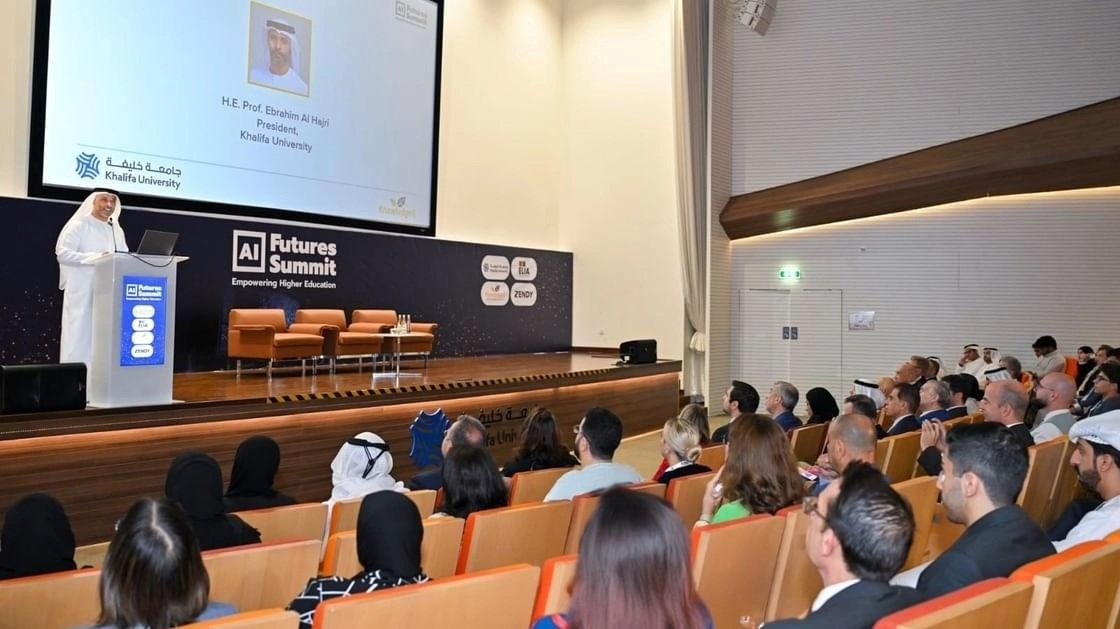
ABU DHABI: An artificial intelligence platform being used at Khalifa University has reduced professors’ administrative workload by 60%, according to the university’s president, as Abu Dhabi pushes to make AI a larger part of education from schools through higher education.
Prof. Ebrahim Al Hajri, President of Khalifa University of Science and Technology, disclosed the figure during Ai Everything Abu Dhabi, held at ADNEC Centre on October 6-7, 2026. He said the system has reduced the time academics spend on class preparation, setting examinations and grading.
The reported time saving is significant because those activities account for a substantial part of the routine work surrounding teaching. The university’s approach is aimed at allowing academics to devote more time to research, teaching and helping students apply knowledge in practical settings, Al Hajri said.
AI moves beyond content generation
The platform is designed around a more connected learning model rather than simply providing students with a chatbot.
According to Al Hajri, each student can have an AI assistant working with course material across different years of study. The idea is to connect foundational subjects with the skills students will eventually need in their careers, helping learners understand why a particular subject is relevant rather than treating individual courses as isolated requirements.
That approach also changes the role of the professor.
Al Hajri said AI could increasingly handle parts of the preparation and assessment process, while instructors concentrate on activities that require human judgement, including applying theory to real-world problems, managing collaborative projects and bringing professional experience into the classroom.
He expects the technology to become more capable over the next two years, including preparing lessons and helping instructors form student groups according to different abilities such as leadership and technical skills. These are projections described by the university president rather than confirmed future capabilities already deployed at the university.
From university classrooms to Abu Dhabi schools
Khalifa University’s AI education work is also moving into the school sector.
Al Hajri said the platform has been rolled out to private schools in Abu Dhabi, with more than 220 teachers trained. The next stage involves extending access through the TAMM government-services ecosystem, potentially reaching around 220,000 private-school students.
The planned expansion comes as Abu Dhabi is already developing a broader AI-literacy framework for private education.
The Abu Dhabi Department of Education and Knowledge (ADEK) said in September that its AI Literacy initiative was being advanced across more than 170 private schools. The programme covers learning from kindergarten through Grade 12, with students gradually progressing from understanding AI concepts and evaluating AI-generated information to designing AI-based solutions.
ADEK’s framework also places limits on how AI should be used. Its policy addresses student privacy, academic integrity, human oversight of AI-generated decisions, content safety and algorithmic fairness. The authority is targeting 19,000 educators for AI training and upskilling through a three-level professional development programme.
That means the Khalifa University platform is entering an education environment where AI adoption is increasingly being paired with rules intended to protect independent thinking and human judgement.
A different model for professors
The wider question is not whether AI can produce teaching material faster, but how universities divide work between people and machines.
Al Hajri described a future in which students could spend part of their learning time using AI-supported systems to build theoretical knowledge, while instructors take on more of an “orchestrator” role — guiding projects, introducing industry problems and helping students turn knowledge into practical solutions.
That model is consistent with Khalifa University’s broader push to integrate AI into its academic and institutional activities. Prof. Azzam Mourad, the university’s Vice President and Advisor for AI and Digital Transformation, leads AI transformation initiatives across management, operations and academic areas. He is also the founder of InstrucTwin, an agentic-AI instructor digital-twin platform designed for adaptive learning, assessment, tutoring and institutional insight.
Khalifa University has also joined the Digital Education Council, a global network focused on digital education and the adoption of AI in higher education and workforce development.
Why the shift matters for UAE education
The development comes as Abu Dhabi positions AI as part of the infrastructure of future education rather than simply another digital tool.
Ai Everything Abu Dhabi, held at ADNEC Centre on October 6 and 7, brought together AI companies, government leaders, investors and researchers to examine practical applications of the technology. WAM reported that the 2026 event opened with more than 400 AI exhibitors and over 180 speakers.
For universities, the potential benefit is straightforward: if routine academic administration can be reduced, faculty members can spend more time on research and direct engagement with students.
But the transition also leaves human judgement at the centre of education. Abu Dhabi’s school AI framework explicitly requires safeguards around privacy, academic integrity and human oversight, while Khalifa University’s own approach emphasises the continuing role of instructors in applying knowledge and developing students’ broader capabilities.
The 60% reduction reported at Khalifa University is therefore best understood as a measure of administrative time saved, not a claim that AI is replacing professors. The university’s stated direction is to use that recovered time to change what academics and students do with their time — from routine preparation and grading towards research, mentorship, collaboration and applied learning.
What happened at Khalifa University?
Khalifa University President Prof. Ebrahim Al Hajri said an AI platform has reduced professors’ time spent on class preparation, exam setting and grading by 60%.
How much has the AI platform reduced professor administrative time?
According to Al Hajri, the reduction is 60% for the administrative work associated with class preparation, exam setting and grading.
What does Khalifa University’s AI platform do?
The platform provides students with AI-supported learning connected to their course material and is intended to assist with areas including preparation, assessment and learning support.
Is AI replacing professors at Khalifa University?
No. The university’s stated model is to use AI to reduce routine work while allowing instructors to focus more on applied learning, research, mentoring and human interaction.
Will the platform be available to school students?
The university president said the system is being extended through TAMM with potential access for about 220,000 private-school students in Abu Dhabi.
How many Abu Dhabi private schools are covered by the wider AI education initiative?
ADEK said its AI Literacy initiative is being advanced across more than 170 private schools in Abu Dhabi.
How many teachers does ADEK plan to train in AI?
ADEK is targeting 19,000 educators for AI training and upskilling through its professional development programme.
Where was the announcement about the university’s AI platform made?
Prof. Ebrahim Al Hajri discussed the platform during Ai Everything Abu Dhabi, held at ADNEC Centre on October 6-7, 2026.
