
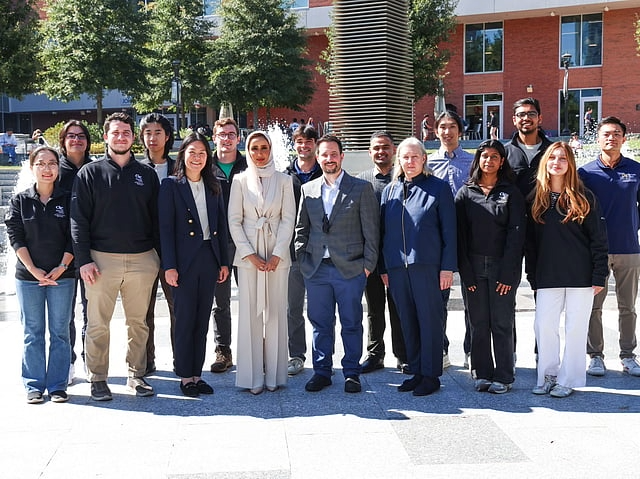
Abu Dhabi: The UAE is backing a new international research project that aims to turn atmospheric moisture into a potential source of freshwater, bringing together three leading universities to develop a system designed to work across different humidity conditions.
The Mohamed bin Zayed Water Initiative announced on November 17, 2026, that its first Water Catalyst Research Grant would support a two-year partnership between the United Arab Emirates University (UAEU), the Georgia Institute of Technology (Georgia Tech) and the Massachusetts Institute of Technology (MIT).
The research will focus on atmospheric water harvesting, a process that captures moisture present in the air and converts it into usable water. The objective is to develop a more energy-efficient system that could eventually offer another water-production option for regions facing limited freshwater supplies.
The grant agreement was signed at Georgia Tech in the United States, formally launching the collaboration.
How will the technology collect water from the air?
The research team plans to combine two different moisture-collection methods within one integrated system.
The first uses hygroscopic salt-impregnated hydrogels. These are specially developed materials that attract and absorb moisture from the surrounding air. The captured water can then be collected through a suitable release and recovery process.
The second component involves engineered mesh membranes designed to capture water droplets from fog and humid air.
Bringing the two approaches together could allow the system to operate under a wider range of atmospheric conditions than a solution relying on just one moisture-collection method.
The researchers also want to reduce the energy required to produce water. This is an important part of the project because the practical value of atmospheric water harvesting depends not only on how much moisture a device can collect, but also on the energy and resources needed to operate it.
The initiative has not yet announced a confirmed water-production capacity, commercial launch date or final performance figures for the proposed system.
Three universities combine their research expertise
The project is led by Dr Bachir El Fil, an assistant professor at Georgia Tech’s George W. Woodruff School of Mechanical Engineering.
Each participating institution will contribute expertise in areas including materials development, atmospheric water harvesting and engineering system design.
The UAE’s participation through UAEU also creates an opportunity to examine the technology in conditions relevant to water-stressed environments.
Ayesha Al Ateeqi, CEO of the Mohamed bin Zayed Water Initiative, said the programme was established to help promising research move beyond laboratory development towards practical applications.
The initiative’s first research grant is intended to support collaboration and accelerate the development, testing and validation of emerging water technologies.
For UAEU, the partnership is part of its wider research focus on solutions to global challenges. The university’s Vice Chancellor, Professor Ahmed Al Raeesi, described water security as an urgent priority and highlighted the value of combining international academic expertise.
Why is producing water from atmospheric moisture important?
Freshwater availability is a continuing challenge in arid regions, including the Gulf. Countries in the region have invested heavily in desalination, groundwater management, water recycling and infrastructure to maintain reliable supplies.
Atmospheric water harvesting offers another possible approach. Instead of drawing directly from seawater or underground reserves, the technology attempts to collect moisture already present in the atmosphere.
However, its effectiveness depends on local conditions.
Humidity, temperature, air movement and the technology used can all influence how much water an atmospheric harvesting system produces. A system that performs well in a humid coastal environment may deliver different results in a hot, dry inland location.
This is particularly relevant to the UAE, where environmental conditions vary between coastal areas, urban centres and desert regions.
The proposed combination of moisture-absorbing hydrogels and fog-collecting membranes is intended to address some of these operating challenges.
It could eventually be relevant to locations where conventional water infrastructure is difficult or expensive to establish. But further research will be needed before its suitability for households, agriculture or large-scale water production can be assessed.
UAE expands support for water technology research
The Water Catalyst Research Grant is part of the Mohamed bin Zayed Water Initiative’s broader efforts to encourage innovation in water security.
According to the initiative’s official programme information, the grant supports technologies at different development stages, including early research, prototype construction, testing, validation and pilot demonstrations.
Its application programme is open to eligible organisations and research teams internationally, with a focus on technologies that could address water challenges in the UAE and other regions with similar conditions.
The initiative also supports other programmes, including XPRIZE Water Scarcity and the Al Miyah Challenge for Agriculture.
The new university partnership therefore represents more than an individual research project. It is the first award under a funding programme intended to help promising water technologies progress towards practical use.
For now, the immediate task is to develop and test the integrated system. Whether it can deliver reliable quantities of freshwater at an affordable cost, particularly under the UAE’s demanding climatic conditions, will become clearer as the research progresses.
Q1. What is the UAE’s new water-from-air research project?
The Mohamed bin Zayed Water Initiative is funding a two-year research partnership between UAEU, MIT and Georgia Tech to develop technology that collects freshwater from atmospheric moisture.
Q2. Which universities are involved in the project?
The three institutions are the United Arab Emirates University, Georgia Institute of Technology and Massachusetts Institute of Technology.
Q3. How will the technology extract water from air?
It will combine salt-impregnated hydrogels that absorb atmospheric moisture with engineered mesh membranes that collect water from fog and humid conditions.
Q4. Who is leading the research project?
Dr Bachir El Fil, Assistant Professor at Georgia Tech’s George W. Woodruff School of Mechanical Engineering, is leading the project.
Q5. How long will the research project last?
The announced research partnership is planned to run for two years.
Q6. What is the Water Catalyst Research Grant?
It is a Mohamed bin Zayed Water Initiative funding programme supporting the development, testing and validation of innovative water technologies, including prototypes and pilot projects.
Q7. Will the technology provide drinking water to UAE residents immediately?
No. The project is currently a research and development collaboration. Commercial availability, production capacity and drinking-water suitability have not been established.
Q8. Why is atmospheric water harvesting relevant to the UAE?
The technology could provide an additional source of freshwater in water-stressed environments. Its practical usefulness in the UAE will depend on performance under local humidity and temperature conditions, energy requirements and production costs.
