
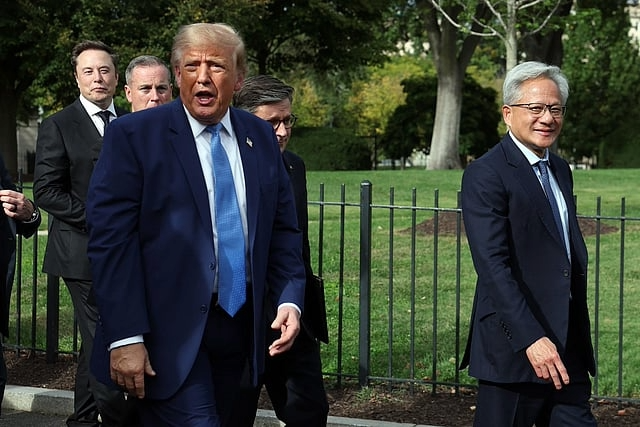
Nvidia is approaching one of its closely watched financial announcements of the year with investors facing an unusual question: can the world’s leading AI chipmaker maintain confidence during a sudden change at the top?
The US technology company is scheduled to release its third-quarter fiscal 2027 results on November 17, 2026, following the resignation of co-founder and former chief executive Jensen Huang. The announcement comes as US President Donald Trump has publicly backed the possibility of Huang returning to the company, adding another dimension to an already unsettled leadership situation.
Trump told reporters on November 16 that he would not object to Huang returning as Nvidia’s chief executive. He said the former CEO had learned a lesson and acknowledged that a large group of people wanted him back.
However, Trump’s comments do not represent a change in Nvidia’s official leadership arrangements. The company’s board has reportedly continued its search for a permanent CEO and is not considering Huang’s reinstatement, according to people familiar with the board’s position cited by Reuters.
The immediate focus for investors is now Nvidia’s financial performance, its outlook for AI-related demand and whether the management transition will affect its longer-term business strategy.
Nvidia prepares for earnings announcement amid uncertainty
Nvidia’s third-quarter fiscal 2027 report covers the three-month period that ended on October 25, 2026.
The company confirmed in an October 28 announcement that it would publish its results on November 17, with a conference call scheduled for 2pm Pacific Time. The financial release is scheduled for approximately 1.20pm Pacific Time.
For investors, the figures will provide an opportunity to assess whether demand for Nvidia’s processors and accelerated computing products continues to support its growth.
Nvidia has become a central supplier to the artificial intelligence industry. Its graphics processing units (GPUs) are used in data centres and computing infrastructure operated by major technology companies developing and running AI systems.
Investors will therefore be watching revenue, profitability, data-centre performance and management’s guidance for the coming quarters.
The leadership controversy adds another consideration. Even if the financial results meet expectations, questions about the company’s executive succession and strategic direction could influence how investors interpret its outlook.
Why Jensen Huang’s resignation matters
Nvidia announced on November 12 that Jensen Huang had resigned as president, CEO and a member of its board, effective immediately.
The company appointed its chief financial officer, Colette Kress, as interim CEO while beginning the process of selecting a permanent replacement. Kress will continue to oversee the finance function alongside her temporary leadership responsibilities.
Harvey C. Jones was appointed the company’s first-ever board chair.
The announcement followed reports concerning Huang’s personal relationships and his alleged connections with Alice Huang, an executive associated with Megaspeed, a company reportedly under US investigation over suspected transfers of Nvidia technology to China.
The allegations have raised questions involving corporate governance and national security. However, allegations and reported suspicions should not be treated as established findings.
Nvidia’s official announcement confirmed the resignation and leadership appointments but did not provide a detailed public explanation of the circumstances behind Huang’s departure.
Huang’s exit is particularly important because of his long association with Nvidia. He co-founded the company in 1993 and spent more than three decades building its position in graphics processing, accelerated computing and artificial intelligence.
His departure has therefore created a succession challenge involving more than simply filling an executive position.
Trump supports a possible comeback, but Nvidia’s board has not agreed
Trump’s comments have intensified attention around the possibility of Huang returning.
Speaking to reporters before departing Washington for an Asia trip on November 16, the US president said he would not mind seeing the former CEO reinstated. He also suggested that the allegations surrounding Huang could be discussed during his engagement with Chinese President Xi Jinping.
The comments followed a growing campaign among technology industry figures and Nvidia supporters calling for Huang’s return.
Reuters reported on November 16 that more than 180,000 people had signed a petition supporting his reinstatement. Elon Musk was among the prominent technology figures backing the campaign.
However, public support does not determine Nvidia’s leadership decisions.
According to Reuters, three people familiar with the matter said the board was not weighing Huang’s return. The company is instead proceeding with its leadership transition.
That distinction matters for shareholders. Trump’s position is a political endorsement, not a corporate appointment or confirmation that negotiations over Huang’s return are taking place.
What investors will be watching in Nvidia’s results
Nvidia’s quarterly announcement will be important for understanding the health of the wider AI infrastructure market.
Several areas are likely to attract attention:
-
Data-centre revenue: Investors will examine whether demand from companies building AI infrastructure remains strong.
-
Profitability: Margins and operating performance will help show how effectively Nvidia is converting demand into earnings.
-
Future guidance: Management’s expectations for the next quarter will be important in assessing whether growth can continue.
-
AI infrastructure spending: Investors will look for signs that major technology companies are maintaining their investments in computing capacity.
-
Leadership continuity: The market will also watch whether the change in management affects strategic priorities, partnerships and long-term investment decisions.
The financial announcement will be particularly relevant because Nvidia’s business extends beyond individual consumer graphics cards. Its technology supports large-scale computing infrastructure used by cloud providers, technology companies and AI developers.
A change in executive leadership could attract attention across this ecosystem, even if day-to-day operations continue as planned.
Nvidia shares face additional scrutiny
Nvidia’s share performance has also reflected investor concerns surrounding the leadership controversy and the broader AI investment environment.
According to the AFP report published by Gulf News on November 17, Nvidia shares fell approximately 4% on Monday, November 16. The report also described a wider decline in the company’s share price during the preceding month.
These movements should be considered alongside broader market conditions rather than attributed entirely to Huang’s departure.
Investors are assessing several factors at once, including the sustainability of AI spending, the competitive environment, semiconductor demand and the financial commitments made by companies developing AI infrastructure.
For shareholders, the earnings announcement could provide important information about whether Nvidia’s underlying business performance remains strong despite the leadership disruption.
The company’s ability to maintain confidence among customers, employees and investors will be closely watched as the board searches for a permanent CEO.
For now, Colette Kress remains in charge as interim chief executive, while Nvidia prepares to deliver its latest financial results.
Q1. Why is Nvidia facing an earnings test in November 2026?
Nvidia is preparing to announce its third-quarter fiscal 2027 results while dealing with the resignation of co-founder Jensen Huang. Investors are watching both its financial performance and the leadership transition.
Q2. When will Nvidia announce its Q3 fiscal 2027 results?
Nvidia has scheduled its results announcement for November 17, 2026, at approximately 1.20pm Pacific Time, followed by an earnings call at 2pm Pacific Time.
Q3. Why did Jensen Huang leave Nvidia?
Huang resigned as CEO and board member on November 12, 2026, following controversy involving reported personal relationships and national-security concerns. The circumstances have attracted scrutiny, but allegations should not be treated as proven findings.
Q4. Does Donald Trump support Jensen Huang returning to Nvidia?
Yes. Trump said on November 16 that he would not mind seeing Huang return as CEO and suggested the former executive had learned a lesson.
Q5. Will Jensen Huang return as Nvidia CEO?
There is no confirmed agreement for his return. Reuters reported that Nvidia’s board was not considering reinstating him and was continuing its search for a permanent successor.
Q6. Who is currently leading Nvidia?
Nvidia CFO Colette Kress is serving as interim CEO following Huang’s resignation.
Q7. Why are Nvidia’s earnings important for the AI industry?
Nvidia supplies processors and computing technology used in AI data centres. Its financial results provide an important indication of demand for AI computing infrastructure.
Q8. Can Nvidia’s leadership change affect its investors?
Potentially. Investors may consider leadership stability, future strategy, business performance and management guidance when assessing the company’s prospects. The actual market impact will depend on several factors.
