
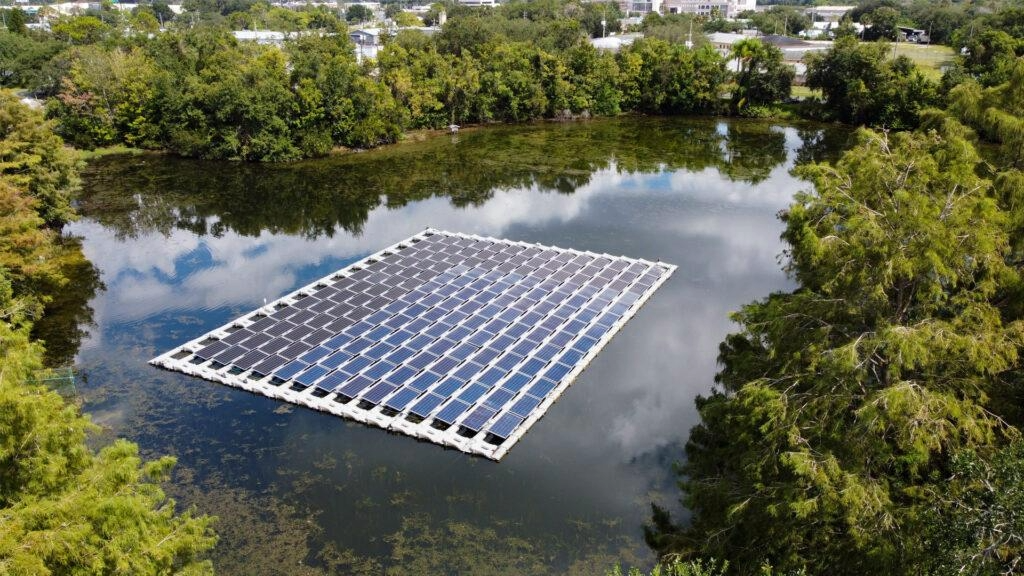
Florida is finding a new use for thousands of artificial ponds built to manage rainwater: generating electricity. Solar panels mounted on floating platforms are being installed on selected water bodies, offering an alternative to traditional solar farms that require large areas of land.
The approach, known as floating photovoltaic technology or floating solar, is attracting attention as electricity demand grows and renewable energy developers look for additional sites. Florida is particularly suited to the concept because of its extensive network of stormwater ponds, many of which are located close to urban communities and existing electricity infrastructure.
The expansion is also supported by state legislation that encourages floating solar installations on designated water-storage areas.
Falling costs are making floating solar more attractive
Floating solar systems use buoyant platforms to support photovoltaic panels on the surface of reservoirs, wastewater ponds and other suitable water bodies. The electricity generated can then be connected to the power grid.
The technology is becoming more commercially attractive as installation costs decline. According to figures cited by the Associated Press, the median reported cost of floating solar projects fell from $2.41 per watt in 2015 to $1.25 per watt in 2024, representing a reduction of approximately 48%.
However, floating installations remain more expensive upfront than conventional ground-mounted solar projects. Published comparisons cited in the report indicate a cost premium of around 10% to 25%.
Despite the additional expense, the technology offers an advantage in areas where suitable land is limited or expensive. Existing water infrastructure can potentially provide another location for electricity generation without requiring developers to acquire large new land parcels.
Floating solar also has potential operational benefits. Water beneath the panels can help moderate temperatures, potentially improving electricity generation under suitable conditions. Covering portions of a pond may also reduce evaporation.
Florida’s thousands of stormwater ponds create an opportunity
Florida’s geography and development patterns have created an extensive network of artificial ponds.
University of Florida researchers estimate that the state has at least 76,000 stormwater ponds, with the number potentially reaching 100,000 as development continues.
These water bodies are generally constructed to collect rainwater runoff and help manage flooding in residential neighbourhoods, commercial developments and urban areas.
Their existing purpose makes them different from natural lakes and wetlands. Nevertheless, they also support aquatic plants, microorganisms, insects, fish and other wildlife.
Using selected ponds for electricity generation could allow local authorities and utilities to make additional use of existing infrastructure.
Not every pond is suitable for a floating solar installation. Developers must consider its size, water levels, distance from electricity connections, anchoring conditions, maintenance requirements and environmental characteristics.
Orlando’s 2-megawatt project demonstrates the technology
One of Florida’s most prominent examples is operated by the Orlando Utilities Commission (OUC).
On November 6, 2025, OUC announced the launch of a 2-megawatt floating solar installation on Conway Road in Orlando. The project features more than 3,400 solar panels arranged across two floating arrays.
According to the utility, the installation sends electricity directly to the power grid. Its two arrays use different panel orientations, allowing OUC to study how their positioning affects solar generation.
The project represents an important demonstration of how urban water infrastructure can be used for renewable electricity production.
OUC had previously developed smaller floating solar installations, including a 32-kilowatt system and a separate 120-kilowatt project.
The utility’s Conway Road installation demonstrates that floating solar is moving beyond small experimental systems towards larger electricity-generating projects.
Highway stormwater ponds could offer further potential
Florida’s opportunities extend beyond municipal utility projects.
Solar developer D3Energy has said it holds exclusive development rights for eligible Florida Department of Transportation stormwater ponds located within state highway rights-of-way.
The company estimates that these potential installations could collectively generate more than one gigawatt of electricity.
That figure represents estimated potential, not installed or currently operating generating capacity.
If developed, such projects could provide additional renewable electricity while making use of water-storage areas associated with existing transport infrastructure.
The commercial viability of individual sites would still depend on engineering requirements, grid access, permitting and environmental assessments.
Hurricane resistance remains an important consideration
Florida’s exposure to severe storms makes structural durability a key requirement for any floating solar installation.
Unlike conventional ground-mounted systems, floating arrays must be designed to accommodate changing water levels while remaining securely anchored during strong winds.
According to the Associated Press report, Orlando Utilities Commission’s installations are designed for changing pond levels and local wind conditions.
D3Energy also reported that none of its floating solar systems experienced structural damage during Hurricane Milton in 2024.
These reported operating experiences offer encouraging signs, but they do not mean every floating solar design is automatically suitable for hurricane-prone locations. Engineering standards and site-specific assessments remain essential.
Scientists warn about possible effects on aquatic ecosystems
The expansion of floating solar also raises environmental questions.
Stormwater ponds are not simply unused water surfaces. They perform several functions, including managing rainwater runoff, supporting aquatic habitats and helping regulate nutrients and sediments.
Solar panels can reduce the amount of sunlight reaching the water. Depending on how much of the surface is covered, this may affect photosynthesis, algae growth and submerged vegetation.
Changes in sunlight and water temperature can also influence oxygen levels and the organisms living within the pond.
Researchers are therefore examining how floating installations might affect water quality, nutrient processing and aquatic food webs over time.
The appropriate amount of surface coverage remains an important question.
Orlando Utilities Commission aims to keep floating panels within approximately 70% to 80% of a pond’s surface, depending on maintenance requirements and ecosystem conditions, according to the AP report.
However, scientists have not established a universal coverage threshold that guarantees there will be no significant ecological changes.
The challenge is to ensure that renewable energy development does not undermine the environmental and water-management functions these ponds were originally built to provide.
Floating solar remains a developing part of the renewable energy market
Floating photovoltaic installations have expanded internationally since the technology’s early projects in Japan in 2007.
By the end of 2024, global installed floating solar capacity had exceeded 9.6 gigawatts across 66 countries and regions, according to figures attributed to researcher Oktoviano Gandhi in the Associated Press report.
Asia accounts for approximately 90% of that installed capacity, with mainland China representing a substantial share.
Although floating solar still contributes less than 1% of global solar capacity, falling costs and growing experience with the technology could encourage further development.
Florida’s approach offers a practical example of how existing infrastructure might contribute to renewable electricity generation. Its long-term success, however, will depend on balancing energy production, construction costs, water management and ecological protection.
For now, the state’s stormwater ponds are attracting attention as a potential additional resource in the transition towards cleaner electricity.
Q1. What is floating solar technology?
Floating solar is a renewable energy system in which photovoltaic panels are installed on buoyant platforms placed on reservoirs, ponds or other suitable water bodies.
Q2. Why is Florida installing solar panels on stormwater ponds?
Florida has thousands of artificial ponds, many located near urban electricity infrastructure. Using suitable ponds for solar generation can reduce the need for additional land.
Q3. How many stormwater ponds does Florida have?
University of Florida researchers estimate that Florida has at least 76,000 stormwater ponds, with the number potentially reaching 100,000.
Q4. How much has floating solar technology become cheaper?
The median reported project cost declined from $2.41 per watt in 2015 to $1.25 per watt in 2024, a reduction of approximately 48%.
Q5. What is Florida’s largest floating solar installation mentioned in this report?
The Orlando Utilities Commission’s Conway Road installation is a 2-megawatt project featuring more than 3,400 panels. It was launched in November 2025.
Q6. Can floating solar panels survive hurricanes?
Some Florida operators report that their systems have operated through hurricanes. However, installations require suitable anchoring and engineering to withstand local wind conditions and changing water levels.
Q7. Do floating solar panels affect aquatic ecosystems?
They can. Shading may affect sunlight penetration, photosynthesis, oxygen levels, aquatic plants and food webs. Researchers are still studying the long-term environmental effects.
Q8. Is floating solar cheaper than traditional solar energy?
Not necessarily. Floating solar has become less expensive, but reported comparisons indicate that its upfront costs can still be around 10% to 25% higher than comparable ground-mounted systems.
