
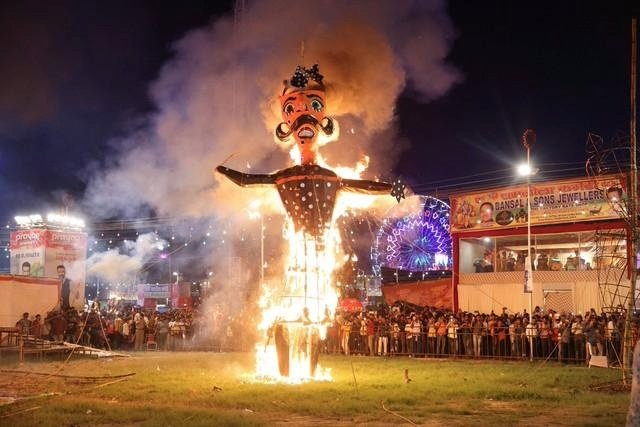
Dussehra, also known as Vijayadashami, is being celebrated across most of India on Tuesday, October 20, 2026, bringing the Navratri season to a close and keeping traditional stories of courage, justice and the triumph of good over evil at the centre of festivities. The festival is marked by different customs, from the burning of Ravana’s effigy to prayers honouring Goddess Durga and rituals associated with new beginnings.
For many communities, Dussehra recalls Lord Rama’s victory over Ravana in the Ramayana. In other parts of India, the day celebrates Goddess Durga’s defeat of the buffalo demon Mahishasura. Both traditions give Vijayadashami its central meaning: the defeat of destructive forces and the restoration of righteousness.
The festival is observed by Indian communities around the world, including residents of the UAE, where Dussehra forms part of the wider Indian festive season leading towards Diwali.
Why is Dussehra celebrated?
The best-known story behind Dussehra comes from the Ramayana, one of India’s major epic narratives. According to the story, Ravana, the king of Lanka, abducted Sita, the wife of Lord Rama. Rama, supported by Lakshmana, Hanuman and an army of allies, fought Ravana to rescue her.
Rama’s victory is commemorated on Vijayadashami. The burning of Ravana’s effigy represents the defeat of wrongdoing and the victory of righteousness.
Ravana is traditionally depicted with ten heads. Although he is portrayed as a powerful ruler and learned figure in the epic, his actions and misuse of power ultimately lead to his downfall. The story is therefore remembered not simply as a battle between two characters, but also as a lesson about the consequences of arrogance and injustice.
The name Dussehra is commonly associated with the Sanskrit elements dasha, meaning ten, and hara, meaning defeat or removal. The festival is also known as Vijayadashami, referring to victory on the tenth day.
The story of Goddess Durga’s victory
Dussehra has another important religious meaning, particularly in eastern India, where Vijayadashami concludes Durga Puja.
According to Hindu tradition, Goddess Durga fought Mahishasura, a demon who had become a threat to the gods. Her victory is celebrated as the triumph of divine power over evil.
In West Bengal and other eastern regions, Vijayadashami is closely associated with the final rituals of Durga Puja and the farewell to the goddess’s idols. The celebrations differ from the Ravana effigy-burning ceremonies commonly associated with northern India, but both traditions share a theme of victory over destructive forces.
Why are Ravana’s effigies burned?

One of the most recognisable Dussehra traditions is Ravan Dahan, the ceremonial burning of Ravana’s effigy.
In many towns and cities, organisers stage performances of the Ramayana, known as Ramlila, in the days leading up to the festival. These performances recount key events from Rama’s exile to the final battle with Ravana.
The celebrations often culminate in the burning of large effigies of Ravana, sometimes accompanied by effigies of his brother Kumbhakarna and son Meghnad, also known as Indrajit. The ritual is typically held in the evening and attracts families to public grounds and organised community events.
The effigies are usually made from lightweight frameworks covered with paper and fabric. Their size and design vary according to local traditions and the resources of the organising committees.
However, Ravana’s effigy is not burned everywhere. India’s regional traditions are diverse, and some Dussehra celebrations focus on different deities, historical customs or local religious practices.
How Dussehra is celebrated across India
The festival has no single national format. Its rituals reflect the religious and cultural traditions of the communities observing it.
-
Northern India: Ramlila performances and Ravana effigy-burning ceremonies are prominent features of Dussehra celebrations.
-
West Bengal and eastern India: Vijayadashami marks the conclusion of Durga Puja, with rituals associated with Goddess Durga and the immersion of her idols.
-
Mysuru, Karnataka: Dasara is known for its royal heritage, illuminated Mysuru Palace and ceremonial processions.
-
Maharashtra: Families may perform Shastra Puja, honouring weapons, tools and other objects associated with work, alongside traditions involving Shami or Apta leaves.
-
Kullu, Himachal Pradesh: The local Dussehra celebration follows a distinct tradition, beginning after Vijayadashami and centring on Lord Raghunath and a gathering of regional deities.
These differences are important: the absence of a Ravana effigy does not mean a community is observing the festival incorrectly. Dussehra has developed through different regional histories and religious narratives.
What does Dussehra have to do with Diwali?
Dussehra is part of the wider autumn festive season in India, which continues towards Diwali.
In the Ramayana tradition, Rama’s return to Ayodhya follows his victory over Ravana. Diwali is associated with the welcoming of Rama, Sita and Lakshmana through the lighting of lamps, although Diwali also has other religious meanings and is celebrated differently across communities.
The festivals are separate occasions on the Hindu calendar. Dussehra falls on Vijayadashami, while Diwali takes place later, on a different lunar-calendar date.
For Indian families in the UAE, the period can bring opportunities to celebrate with relatives, attend community events and share traditional food and customs. Specific events and timings depend on local organisers and venues.
Dussehra’s enduring significance lies in the stories it preserves and the traditions through which communities pass them to the next generation. Whether observed through a public Ramlila performance, prayers to Goddess Durga or a family ritual at home, Vijayadashami remains a day associated with victory, renewal and the beginning of something new.
1. When is Dussehra in 2026?
Dussehra falls on October 20, 2026, across most of India. Some regional observances may follow different dates because of local customs and calendar interpretations.
2. Why is Dussehra celebrated?
Dussehra celebrates the victory of good over evil. It is associated with Lord Rama’s defeat of Ravana and, in other traditions, Goddess Durga’s victory over Mahishasura.
3. Why do people burn Ravana’s effigies?
The ritual, known as Ravan Dahan, symbolises the defeat of wrongdoing and the victory of righteousness. It is a prominent tradition in many parts of northern India.
4. What is the difference between Dussehra and Vijayadashami?
The names are commonly used for the same festival, observed on the tenth day associated with the end of Navratri. Regional traditions determine which religious stories and rituals receive the most emphasis.
5. Why is Dussehra celebrated after Navratri?
Dussehra marks the tenth-day celebration following the nine-night Navratri period in many Hindu traditions. It commemorates victory over evil and brings the festival period to a close.
6. How is Dussehra celebrated in Maharashtra?
Celebrations can include prayers, Shastra Puja, the worship of tools and weapons, and the exchange of Apta or Shami leaves. Practices vary among families and communities.
7. Is Dussehra connected to Diwali?
Yes. In the Ramayana tradition, Dussehra commemorates Rama’s victory over Ravana, while Diwali is associated with Rama’s return to Ayodhya. Diwali takes place later on the Hindu calendar.
8. Do people in the UAE celebrate Dussehra?
Indian expatriates and other interested communities in the UAE may observe Dussehra through prayers, family gatherings and community celebrations. Event schedules and arrangements depend on the individual organisers.
